
Tuesday, August 13, 2019
Mugshot: Centaurea deflexa

Monday, July 29, 2019
High and Low Watermarks for hardy Yuccas

In one day last week, I had the unusual pleasure of experiencing what is among the tallest (hardy) Yuccas, and also the smallest.

While Yucca faxoniana (above, one of my four favourite species, zone 5), rostrata, and thomsoniana, may all be capable of growing taller trunks, they are not as hardy and certainly don't boast the bloom stalk size of Yucca elata. My timing was accidentally perfect to see it in bloom at my friend John Stireman's outside of Salt Lake City.
 He measured the top of the stalk at 23 feet (exactly 7 m) with image software. It has bloomed before but never quite so high. I stalk this plant frequently and have never known one with such long, stiff, inflorescences.
Yucca elata (the "Soaptree") is from the Arizona and New Mexico vicinity, accustomed to mercurial and extreme southern plains weather. It has a reputation for HATING transplanting when large, usually dying or at least dying to the ground and losing any trunk it has grown. Many guess that it has deep roots which do not branch out from where they are cut off. In pots in the nursery, I find it a bit slow compared to most species. Don't let that stop you from planting it for posterity- these are mild challenges. Just don't miss an opportunity to buy it or sow it when you can, leave it the hell alone in your garden, and make an investment for the future.
Then I took off to South-Central Utah.

I try not to get political. But I spent some long nights researching, measuring dried flower bits, reading, and mapping this "Yucca nana" critter. The species is not a botanically accepted name, but it is widely used in horticulture. After all that research, I must totally agree with science. My opinion as a not-real-botanist is that it is a horticulturally and aesthetically fun form, but according to the rules of botany and science, does not warrant new species status. Its dimensions fall within harrimaniae, and there are several non-isolated populations, most of whose edges intergrade into larger forms of Yucca harrimaniae- some of whom have 2-3' (up to 1m) leaves. Not a clean distinction. Don't get me wrong- I love it to death and I wish it could be named so. Maybe we ought to call it Yucca harrimaniae f. nana. It still causes heartthrob in the chests of even the most jaded Western-American plantsmen, and is the cutest thing that can poke an eye out.
There, I wrote it. Sorry friends. I hope you'll still talk to me.
It seems like there is a rule that in landscaping, Yuccas must be planted close near sidewalks where, when they reach their completely unsurprising adult size, will jab passers-by. Then they get cut to the ground for this perceived transgression, but keep limping back from the roots. Sad.

The perfect crevice garden Yucca. It is rhizomatous.


I keep thinking about sparse grasses in semi-desert steppe habitat. I think there is a breakthrough in Steppe gardens we are missing having to do with that. See the little yucca in there? There are limestone fragments under all that. I love the traditionally uncomfortable mix of rock garden and meadow here. Grass and rocks. It makes the designers' mind ask "Is that Ok? Can I do that? Is that legal? Will I get in trouble?"
Let's try it.

Incidentally, John grows Yucca nana, too. For him in his sandy soil, it is not so petite, and grows into a veritable knee-high hedge that looks like a pile of giant, clean, sea-urchins. He cuts them to the ground occasionally, and they come back.
Size in Yuccas is strongly influenced by both genetics and environment.
Let's not under-appreciate the stalwart year-round presence and humble surprises that Yucca brings us.
Thursday, June 27, 2019
Thistle make you Smile
While I'm out in the desert, finding that the native Cirsium thistles' seeds have all been eaten by bugs, here are the ones in the crevice garden.


Centaurea urvillei.
Get you some.
Soft yellow, not 12" (30cm) tall, red mid-vein to the leaf. Flowers positively structural. Xeric as a lavender, but not moreso. (And, therefore, I expect, incapable of escaping a garden in a dry climate). Our bumblebees are all about it.


Centaurea drabifolia
is the beauty pageant winner in crevice. (especially with Moltkia petrea nearby). Waaaay petite. Under 4 inches (10cm) and lays flat like an odalisque. Blooms hold for a few weeks, and there are several sexy subspecies, one of which floccosa, is cloaked in wooly white fur. All are somewhat xeric and seem quite perennial.
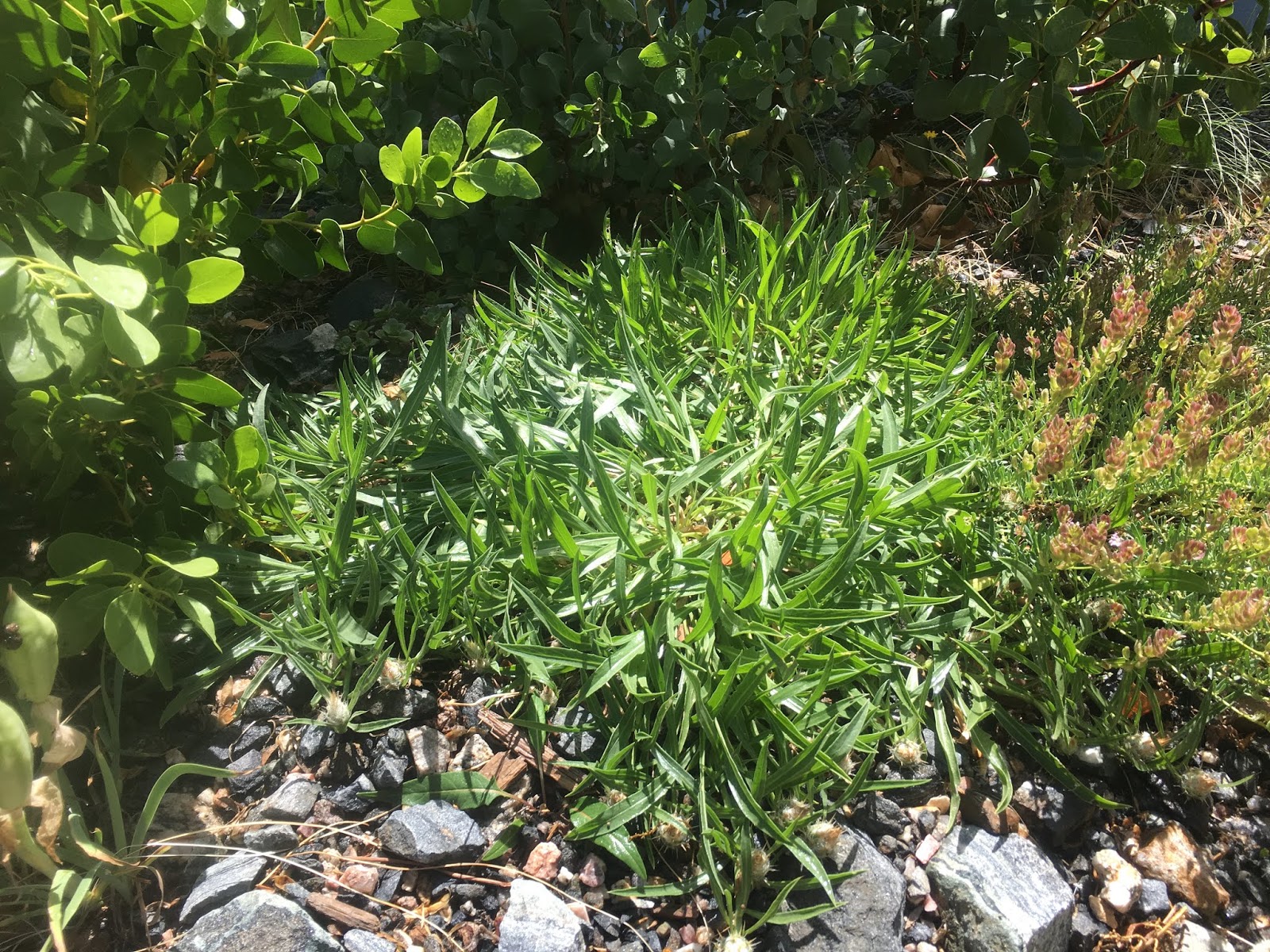

Centaurea deflexa is not well documented, in fact, this may be the first photo on the web, according to google. It seems like it's going to live forever; it has that feeling. I'm not sure why it's my favorite. It does have nice sized booms that lay sideways on the ground. Maybe that it has survived a lot of abuse, from seedpot to the sand mound, and doesn't complain it at all. Three plants are becoming a wild shag-carpet stool cover, and one has made some politely short rhizomes near the plant.
I'm not worried; I'm stoked. More of that plant!


Centaurea montis-borlae
has a pretty classic bachelor's button or strawflower bloom, but with some nice goth dark eyelashes. Also a flat-layer under 3" (7cm) with fun, felted leaves. It comes from crevices in nature but doesn't seem to need them in garden. I like centaureas for their ruggedness, feeding generalist native pollinators, being architectural A.F., and rocking the metal plant vibe. We'd be fools in dryish gardens not to keep more of them. It's taken years to build up a little suite of species in my own garden, so let's hope that growers gather and share their seed so we can all have of bit of the Strawflower/Thistle rainbow in early summer.
Big News (plural)
Much activity this year. Who has time to write about it?
Folks in Denver didn't buy Dracunculus bulbs because it's usually marked "zone 6." Global warming, folks. To prove a point we planted it in Cheyenne. Bulbs experience winter differently- they are effected by long-term cold and not short-term snaps aboveground. They sleep through that crap. That and the magic microclimate explain this:

Dracunculus vulgaris at Cheyenne Botanic, photo credit, Jacob Mares.

I stop in at the APEX garden 3-4 times a year, spending a day or half weeding and cleaning up and removing the cancerous Scuttellaria I got from Denver Botanic gardens. Timed for maintenance, I always miss the peak bloom. ' Till this year!


 There was some rain.


And I was honored some kids from Kew came to see it. It's a triumph of Colorado Horticulture when Brits, the hitherto authorities on rock gardening, come here to see how it's done! But no- Tom and Lara brought some mad sophistication to the table and blew my mind a few times about roots, containers, and public garden infrastructures. Thanks to them for a great day.

 We were unperturbed by the rain. Who could resist a selfie with Lara, queen of the glasshouse? Both the old and new glasshouses at Kew are incredible in totally different ways. Go see them if you are in London.

Anyone out there know what this Eriogonum is? It ate its label, I'm not going to dig it out, and I forgot to record the name when I planted it. Still rocking, with gilt edge leaves and those unusual lavender flowers. It looks nothing like the Eriogonum ovalifolium subspecies I'm familiar with.


I finally get to see Petunia patagonica doing it's thing. Both plants bloomed this year. No seed. I wonder if it needs some wonky Argentine bug to knock it up.
Worth it. Worth the drive from the Western Slope.
 The New Zealand Rock Lily,
Arthropodium candidum
Back home-ish, in my parent's garden, I'm back down to one New Zealand native. It's a tiny bulb with leaves all summer. It's even reseeded. It came from the seed exchanges. I'm splitting it up to see how hardy it is. Maybe the shady north base of the crevice garden is what it needs, or maybe its tougher than that. Trial will tell.


The gentle, floral aroma of the resin which comes from the leaves of Cistus laurifolius gets me every time. It's the one species in that genus that gets away from the hot-tub climate of the mediterranean and wanders up into the cold mountains, which is why it's the hardiest, by far. I've killed lots of them, still, in Colorado, until I realized "DUH!", like all broadleaf evergreens here, shade in winter is worth a lot, so the good one is planted north of the house. The grand, crepe-paper flowers open for just a day, and closing by the late afternoon even- and the show goes for only two weeks at best. But it's worth it.


A new crevice garden at the home of a retired botanist. I'm terrifically excited to see what grows in the climate of Gunnison, Colorado- often credited as being the "coldest city" in Colorado. It was cool and sunny and excellent when I was there pushing 13 tons of granite. Might be the first time I've been able to use actual granite, rather than granitic or related or similar types. It's properly heavy.
I did one in Montrose, Colorado

And got to revisit one in Montrose from year's ago, grown in nicely.
Last year I made just a few crevice gardens. One or two. But I'm doing half a dozen this year.
My contribution waxes and wanes, but meanwhile, I'm heartened to see them gradually, steadily gain interest and become built more and more. People are discovering that they are the best way to grow saxatile plants.
Case in point, a major milestone for Crevice Gardening, is this article in the Washington Post Article by Adrian Higgins. , a couple weeks ago.
Amusing, I've been harassed, like many Americans, by robocalls, spam calls and scamcalls. One day they came by the dozen, and by the perhaps eighth call, I picked up the phone yelling, only to find I was yelling at the lovely Mr. Higgins in Washington, DC who had so kindly called to ask me about crevice gardens for the article.
At least in the top ten of most embarrassing moments in my little life.

The Chinle Cactus Club of Grand Junction, of which I'm a member, is putting one in at the CSU Extension office at the Mesa County Fairgrounds. The club built and has been maintaining this cactus garden garden for 15-20 years; it is often referred to by out-of-towners as the best public garden in Grand Junction. I wouldn't disagree.

Glad it's getting a crevice garden!
Four of us have spent two morning now so far; it's in progress.
Lois lassoed a grant that got us more rock.
 We are tying it in with some horizontal elements to relate to the rest of the garden's existing dry-stacked knee-walls.


Folks in Denver didn't buy Dracunculus bulbs because it's usually marked "zone 6." Global warming, folks. To prove a point we planted it in Cheyenne. Bulbs experience winter differently- they are effected by long-term cold and not short-term snaps aboveground. They sleep through that crap. That and the magic microclimate explain this:

Dracunculus vulgaris at Cheyenne Botanic, photo credit, Jacob Mares.

I stop in at the APEX garden 3-4 times a year, spending a day or half weeding and cleaning up and removing the cancerous Scuttellaria I got from Denver Botanic gardens. Timed for maintenance, I always miss the peak bloom. ' Till this year!

Moltkia petrea just doesn't stop. I hate to note that between it and the Castilleja integra, we've got Bronco Colors there.

Three Maihunia poepigii are in bloom, so here's hoping for seed.
 There was some rain.

(In back- Yucca faxoniana x rostrata in bloom)
And I was honored some kids from Kew came to see it. It's a triumph of Colorado Horticulture when Brits, the hitherto authorities on rock gardening, come here to see how it's done! But no- Tom and Lara brought some mad sophistication to the table and blew my mind a few times about roots, containers, and public garden infrastructures. Thanks to them for a great day.


Anyone out there know what this Eriogonum is? It ate its label, I'm not going to dig it out, and I forgot to record the name when I planted it. Still rocking, with gilt edge leaves and those unusual lavender flowers. It looks nothing like the Eriogonum ovalifolium subspecies I'm familiar with.


I finally get to see Petunia patagonica doing it's thing. Both plants bloomed this year. No seed. I wonder if it needs some wonky Argentine bug to knock it up.
Worth it. Worth the drive from the Western Slope.

Arthropodium candidum
Back home-ish, in my parent's garden, I'm back down to one New Zealand native. It's a tiny bulb with leaves all summer. It's even reseeded. It came from the seed exchanges. I'm splitting it up to see how hardy it is. Maybe the shady north base of the crevice garden is what it needs, or maybe its tougher than that. Trial will tell.


Cistus laurifolius.
The gentle, floral aroma of the resin which comes from the leaves of Cistus laurifolius gets me every time. It's the one species in that genus that gets away from the hot-tub climate of the mediterranean and wanders up into the cold mountains, which is why it's the hardiest, by far. I've killed lots of them, still, in Colorado, until I realized "DUH!", like all broadleaf evergreens here, shade in winter is worth a lot, so the good one is planted north of the house. The grand, crepe-paper flowers open for just a day, and closing by the late afternoon even- and the show goes for only two weeks at best. But it's worth it.


A new crevice garden at the home of a retired botanist. I'm terrifically excited to see what grows in the climate of Gunnison, Colorado- often credited as being the "coldest city" in Colorado. It was cool and sunny and excellent when I was there pushing 13 tons of granite. Might be the first time I've been able to use actual granite, rather than granitic or related or similar types. It's properly heavy.
I did one in Montrose, Colorado

And got to revisit one in Montrose from year's ago, grown in nicely.
Last year I made just a few crevice gardens. One or two. But I'm doing half a dozen this year.
My contribution waxes and wanes, but meanwhile, I'm heartened to see them gradually, steadily gain interest and become built more and more. People are discovering that they are the best way to grow saxatile plants.
Case in point, a major milestone for Crevice Gardening, is this article in the Washington Post Article by Adrian Higgins. , a couple weeks ago.
Amusing, I've been harassed, like many Americans, by robocalls, spam calls and scamcalls. One day they came by the dozen, and by the perhaps eighth call, I picked up the phone yelling, only to find I was yelling at the lovely Mr. Higgins in Washington, DC who had so kindly called to ask me about crevice gardens for the article.
At least in the top ten of most embarrassing moments in my little life.


Glad it's getting a crevice garden!
Four of us have spent two morning now so far; it's in progress.
Lois lassoed a grant that got us more rock.
 We are tying it in with some horizontal elements to relate to the rest of the garden's existing dry-stacked knee-walls.

Cylindropuntia acanthocarpa v. thornberi (I presume) has bloomed from collections I made in Central Arizona. I don't know if it's papa's pride or this one really does have a larger flower than the rest of the kids. Either way, the orange and the streaks get strait at my own personal wacky tastes.

More and more I shy away from "landscaping," which I can now quite distinguish from "gardening," Landscaping has become synonymous with heavy, hard labor for the cheapest price, just to make some dirt disappear and look tamed. (Whereas a garden is a thing created to be a space, made of plants, which also happens to hide the soil, but plants are welcomed to create something synergistic and compelling.) I've given up the "landscaping" business, but I can't let it go- not until I find a way to insert native plants which can go without irrigation into functional domestic "landscaping.' I'll find a fancy effective way sometime, but until then-

I make rare exceptions.

So I think of these as fine landscapes- fulfilling the bill of hiding the dirt, making it low maintenance, and unfussy. But I happen to use special plants (which are low maintenance) and nice design.

The last project, on Patterson Rd in Grand Junction has a troop of deep-rooted Nolina microcarpa (Beargrass) for the wise nurserypeople of the future to collect seed from when it's become illegal to water landscapes and I'm long dead.
The rest of this year is mad. Several more crevice gardens public and private, getting the nursery solid for overwintering, installing irrigation (that's "irritation," misspelled), finally writing all the articles I've promised friends, and doing some last pushes to the book. Next week I'm going to volunteer on the Schachen, in the German Alps outside of Garmisch-Partenkirchen, which is an hour south of Munich. That will certainly be some of the most fun work of the year. Expect a big post all about that historic garden above tree line.

2 gallon bags of homemade compost in our back garden, with the compost bin sitting like a proud momma.
On a final note, we decided to sell some of our twice-a-year-harvest of home compost at BestSlope Coffee Company, from which the coffee grounds come, in an educational effort for the public. A fun little project that probably doesn't break even but it makes us happy.
Subscribe to:
Posts (Atom)