Tuesday, January 21, 2020

Lectures/Programs 2020


Feb 29: 
Reality Check: When natives do and don't work for landscaping and gardens.
Landscaping with Colorado Native Plants Conference, Auraria Campus, Denver.

March 12: Crevice Gardens or TBD
Christchurch Botanic, New Zealand

March 19: Crevice Gardens or TBD
Dunedin, New Zealand

March 20: Crevice Gardens or TBD
Invercargill, New Zealand

April 23: Reality Check: Renovating an existing yard into a xeriscape and actually succeeding.
Waterwise Seminar for Resource Central in Golden, CO

June 9: TBD
Plant Select Annual Meeting, Denver, CO

June 12: Crevice Gardens
New Mexico Master Gardener Conference, (June 11-13) Albuquerque, NM

July sometime: Crevice Garden talk/workshop, with Paul Spriggs,
Far Reaches Farm, Port Townsend, WA

Sept between the 3rd and 6th: Rock Garden Workshop
Inverewe National Trust Garden, Scotland

Sept 9-11, Crevice Gardens & Hardy Cacti and Succulents: Beyond Sedum
Urban Growth Conference: Perennials Plantings Beyond Nature. Malmö, Sweden.


Friday, January 17, 2020

A stroll through the House Range


Last June I took a hike thanks to a friend scouting for the Eriogonum Society conference; it was a great opportunity to see another new example of the puddles of plants that are isolated in the "sky islands" of small mountain ranges in the Great Basin, separated by seas and oceans of steppe and desert.  


The House Range is in West-Central Utah, near Delta, and it is mostly, if not entirely limestone. Perfect territory for good plant richness.  

The stepped-steppe pattern of the limestone ridges inspire me for garden designs that need to be big!


Heuchera rubescens, pinkish when in bloom, is like most dry American Heuchera and loves a nice North crevice.  This species has outliers near where I live in Western Colorado, where we are otherwise dominated by the sweet but boring H. parvifolia. None of them seem really specific about what kind of rock at all.


But the real shocker for me was this primrose.  Primula cusickiana var. domensis.  Sure, it was in mossy seeps, but not wet ones.  Nothing like the drippy places Dodecatheon (now "Primula", too) hangs on when it does show up in the low drylands.  

The "dom" in Primula domensis,  my friend told me was a reference to the House Range to which it is sort-of endemic.  (Like "domicile, domestic") It is arguable how related/similar it is to nearby P. cusickiana subspecies nevadensis... but whatever, let's not get all judgy about its family tree, it's freaking pretty and deserves our respect for being a Primula in the desert.

I've mostly given up on Primroses years ago, which all fainted to death at the mere whisper of forgotten waterings in the garden.  But this gem- it puts up with dry air and heat- I wouldn't mind giving it a go if I ever have the chance!  Look at those lovely eyes!

Tuesday, January 7, 2020

Are You Growing from Seed?


This is that time of year when perennial seed you've ordered, like that from seed exchanges, is coming in the mail.  Or it should be, if you are not.  (the NARGS seedex is still open right now!)If you don't grow your own perennials from seed, you are depriving yourself of a not-too-difficult way to keep you dirty hand in gardening and enrich your garden attainable by no other means.  


The pleasure of seed.


(Arisaema sikkokianum)

Know just two things:

1. It is deeply satisfying- you may grow things you could have never dreamed of or possibly bought.
2. It can be easy, and small. Just a tray in a shadowed place on your patio will do.

Your own plants will be truly more adapted to your climate and garden.  The next generation will be even better.

It provides me with a great deal of wintertime sanity: to watch green things growing under lights in the spare room, to go outside for brief moments to see how cold it really is or isn't- and better appreciate a heated house.  It also forces me to do a little something on a timeline instead of slipping into the depths of winter complacency. Lastly, it breeds excitement and dreams of new and colorful plants- unbridled by the realities (yet) of getting it done. Is there nothing more delicious than looking at seed catalogues?
For rock gardeners, yes: reading Czech seed hunter lists, seed exchange lists, and and googling names they've not heard of.  It sets me on research benders for whole worlds of amazing plants I've never known before.


You can go nuts or stay small. It's up to you. You feel like God if you wind up having a patch of tiny pots like this, seemingly waving up to you with their tiny tags.


I'm not going to write completely about growing rock garden plants from seed, because my friend John wrote a very practical, thorough article here on it.


Most folks find that re-using standard pots they buy plants in is ideal and easy, since they come with trays, but use whatever containers work for you. Egg crates fit into windowsills for things that like indoor temps.


Not all will germinate, and it's not your fault.  The more experimental you are, the lower percent germination, but more lessons learned and higher odds of discovering something very cool.  

If you like to see things grow in the dead of winter, you don't need a home greenhouse. A windowsill or shelf outfitted with fluorescent lights works for species that are happy with house temperatures (or don't need winter stratification- or, have already been stratified)

Lastly, three very easy groups to start with:

1. Aquilegia. Columbines are fast and easy and don't mind being crowded in a pot for a while.
2. Draba. Needs no stratification; I found just days ago. Quick because they are mustards.
3. Yucca. You can start indoors with no strat

The value of a baby plant is so much more when you have known it since it was in a packet that came in the mail.

Or, how else will you be able to enjoy a little gem in your garden you've only seen hiking?

(Erigeron vagus)


Another Concrete One


This crevice garden was a side order.  

I was creating a small, exotic-fruit-tree orchard in Bret's backyard. Pawpaw, Jujube, Kiwi, Figs, trifoliate orange, Che, and the like. Bret is the prez of the local cactus club (his unwatered front yard has the cactus).  The back yard project entailed taking out an old concrete patio to re-pour a larger one. The plan was to have small rock gardens in his re-purposed two 6' (2m) wide (400 gallon) stock tanks, or horse troughs. But instead of buying 3/4 of a dumptruck of rock, it occurred to me mid-way we could use the concrete from the old patio, saving new material costs and disposal costs. It's about 7 tons (6300kilos) of concrete.  


I did break the slabs into deliberately different-sized chunks as I went. I used two different soil mixes to give him options and see what grew mesembs better- he wanted Aloinopsis and Delospermas. One of said mixes is mostly decomposed granite fines. A third trough nearby is full of sand and compost as a vegetable bed.  I cut 4' (1.3m) wide holes in the bottoms of the troughs to  minimize the perched water table and allow complete drainage into the soil below, while keeping some of the base for structural integrity to support the sides. They are essentially raised beds, which are awesome for folks with limited mobility.  Did you know that even galvanized metal still rusts? I didn't. It's just slower. I grew to like the bands of rust, (which are merely on the surface and one side) so I used them and turned them to be featured. the insides I lined with a marine sealant. In retrospect, it's a funny accidental echo of the historical British Alpine trough which came about from using abandoned stone-hewn livestock troughs when they were replaced by metal ones.

 
I used 1/2" (2cm) crushed basalt for the topdressing: a third gray color that intentionally doesn't try to pretend it broke off of the slabs, because I'm not trying to fake a mountain here. It sets off the linear pattern in the design; something I'd want to cover up in a natural garden. The form- the diving in and out of the containers- was inspired by Jiří Papoušek in Prague, who is perhaps the most active crevice garden innovator in the Czech Republic now.


The prettiest things in my designs are always accidents.  Winter colors here: Delosperma nubigenum is red, D. cooperi and friends are a nice green, and the thyme is purple.  I even like the tan/straw-bleached Zauchneria skeleton.  Our first frost was a rude 16 F (-9C) this year, but luckily most plants seemed to have been hardened enough. Except figs- both mine and Bret's look bad; let's hope they return from the ground next year.

Folks often ask about the alkaline nature of concrete.  I've been measuring pH of water with new concrete soaking in it- and it starts strong- like ph11 when it is young; then it mellows down.  It seems that cured concrete is inert- or inert enough that nothing cares. In fact, it is probably a little helpful; more so in wet climates. Its mild long-term basic-ness is on its surface, so as a friend said "broken concrete is basically cheap limestone!" 

While I'm still too much of a nature nut to use concrete for my own personal crevice garden, it's so legitimate.  Rock can be expensive. Crazy expensive, depending on where you live. And we're not all rich; I'm still trying to find a source I can afford for my own home rockery. I think broken concrete not only is a brilliant blue-collar, ecologically-minded garden material, but something that allows gardeners in places where stone isn't even available to have a crevice garden. 

Friday, October 4, 2019

Resistance is Futile: modernist crevice gardens

I hold that there is a spectrum, at least, of the variety of crevice garden, and refuse to be dogmatic about the "best" way. Is there a "best" wing that evolved in nature?  I joked with a friend once that the most modern, non-natural aesthetic a crevice garden could be would be a tilted cube. I probably also said " I won't be the one to build it." Never say never unless you want to be destined to do it.  (Enter the Borg.)


 I had great help from their gardening staff and my friend Joe from the local rock garden club.


A little "easter egg" I tried to keep visible is the stamp from the original, excessively deep, 8" (20cm) concrete poured driveway that this used to be.  1976.


As an exhibit within Aurora Water's Waterwise (Demonstration) Garden in the largest suburb of Denver, Colorado, this will be totally unirrigated once the plants  (spring of next year) are established. We'll use temporary microsprays for the first season.  The soil is real, local, unamended soil, which will settle a lot and need to be topped up after the winter.

Plants to go in will be dry crevice favorites like Hymenoxys scaposa, Escoabria leii ,Yucca "nana," Opuntia debrezyi, a few more, and a trial of Erigeron tener and others like Acantholimon. I'm aiming for clean looking plants, and especially tough buns.  I mean, rugged... buns.

I think we need to keep our definition of crevice gardens open to its fullest extent. I am personally, in my own private sphere, a lifetime disciple of the naturalistic, nature-worshipping rock garden.  But in order to grow and persist, a thing must adapt and evolve. (High Naturalism won't go away any more than books died with the invention of e-readers)  Resistance is futile.


Saturday, September 28, 2019

Don't Be Cheap: Misplaced Values

Folks have said that they don't order from Plant Delights because they're expensive.  Quart pots range from $12-18 for most things, higher for the exotic stuff whose entire American population of that species is on a table in their nursery.  And $35 for such a plant is still not reasonable? How else will you grow you collection of outdoor palms in Colorado?  Be happy you can even buy it and it's not locked behind the beaurocratic bars of the plant zoos of a botanic garden- so many public garden are not allowed to share or sell plant material.

I am also sad to see LaPorte Avenue Nursery closing, which sold alpines for years at ridiculously low prices.  Someone who has the guts to complain about their prices in front of me had better have good health insurance to cover a broken nose.  Plant propagators, our friends, slave over mist tables and potting benches, at the most uncomfortable times of year, every year, have to climb ladders to re-skin their greenhouses and fix leaky boilers without your decent health insurance and we have the audacity to complain about a 2" pot being more than $4?  That's a latte you didn't blink at. How quickly do we forgive technology we buy that lasts less than a year and what, oh what hundreds of dollars, we were willing to pay for it at the time?

Insane. Shameful. 

I often think Far Reaches Farm is similar to Plant Delights. Both hunt plants and  have botanical conservancies as beneficiaries of their profits.  They are also exceptionally good at finding, growing, and shipping amazing plants to your very freaking doorstep. That's amazing. Stop complaining and just hit the "buy" button.  Then, learn to water new plants and not let them die on your back porch, be less lazy about planting them as soon as they harden off in a week, and reap a lifetime of pleasure. 

I want to take this moment to highlight some goodies offered by good people, and maybe publicly announce what I've recently bought.


This Eryngium kick is not ending; I'm insatiable. 
Far Reaches offers a hilarious read on E. caucasicum, which has done well here with fantastic leaves.


PDN sent me this sexy dominatrix, E. venustum, which I'm curious to see respond to our climate.

I also got Hesperaloe funifera ssp. chiangii from them.  H. parviflora keeps showing up more zones north that it ought to, and funifera has secretly been in Denver for ages; it's yawned at the occasional bad winter here: I haven't seen it's edge of hardiness yet. 

Now that I've ordered it and the danger of creating competition is over for this coveted jewel, I can openly say that they offer Allium kiiense again, a fall-blooming east asian species, making pink puffs when yellow leaves hit the ground. They give you the pink autumn thrill of Colchicum without the bigass leaf-mess in spring.
My first A. koreanum/thunbergii/who-cares-its-beautiful.
They grow in Colorado in part shade or with good water. Far Reaches actually offers several varieties of far- east fall-blooming Allium. And no, Far Reaches isn't all moisture-lovers because they are outside Seattle. Check out their Kniphofia.

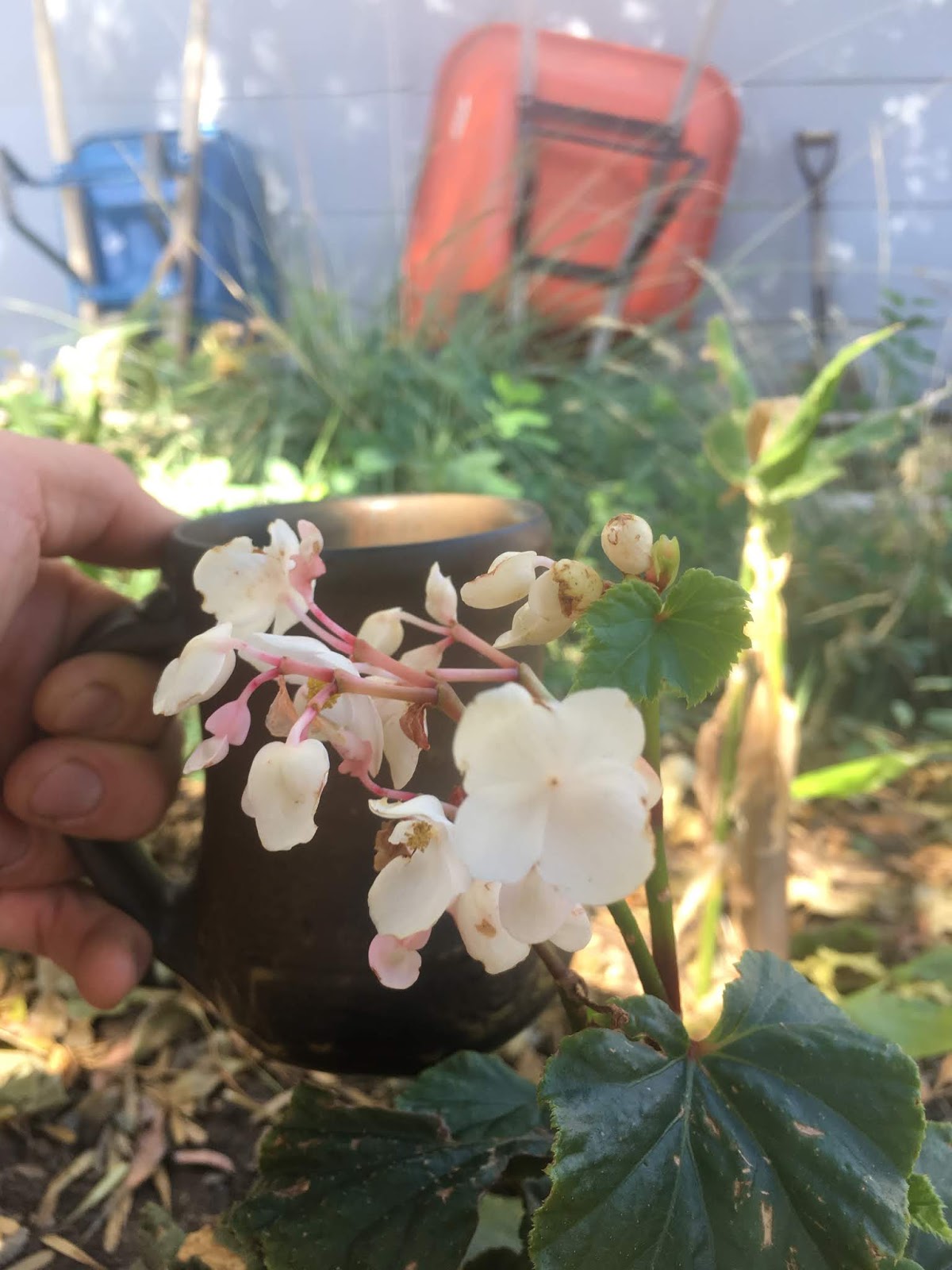
The hardy, (clears throat) the HARDY Begonia grandis blooms today. Thanks Far Reaches.


Furthermore, you know High Country Gardens.  It's fall and the Asters are covered in tiny pollinators none of us can identify that are probably essential for our survival as a species and we don't even know it. I'm on an aster kick, too, finally learning about them after a lifetime of ignorance.  Aster ericoides grows absolutely great without irrigation, has a structure and cleanness that most scrappy, wild sisters don't. HCG is having a fall sale and it's a great time to plant, in my opinion, better than spring, in general, in our climate.  (Except for warm season grasses and agastaches, and maybe Zauschneria.) Hey pollinator heads!  I just said "no water" and "pollinator" at once.  Let's get to work. There is a future of some kickass meadows you should buckle up for, or get left at home.


Since I'm in the mood for shameless (shameful?) plugging, I want to highlight a gem in Denver.  A handmade craft and houseplant shop called All Its Own, currently on West Colfax. Owner William hand-makes some super creative concrete pots, knows the pasts and people behind the individual plants and art pieces he sells at a modest price. This contrasts nicely with the trustfund-backed instagram-sham boutiques which are cloning themselves around earth (including Denver) whose people, God love them, are often afraid of scientific names and certainly have little concept of varied plant needs, meanwhile upcharging by 400%. (Not an invented number. I know where those plants came from!)  Long live All-Its-Own!

William's shop warms my heart, and the love and attention cultivates a nostalgic eternal pleasure of giving houseplants as gifts to friends.  And that's exactly what I like to do while patronizing his shop. He's friends with folks in the cactus club, and they planted up a bed in the parking lot as a cactus garden- a real member of the community.  His shop is the type of fun, local, spot with personality and truly unique charm that used to make Denver fun before the big Tech/Pot boom painted the whole town in modern squares selling modern squares and visited by modern squares. Anyone else remember the African Violet Shop that also sold canaries? Remember when people had their own genuine interests rather than being fed them by cell phone while they sit on the toilet? #instagramculture. We lost something when we gained something. Call me a crotchety old man already (#getoffmylawn) but I don't want to live to be an old man if complexity, nuance, and essence, are devalued and lost.

All the more reason to support specialists and stay the hell away from the plant racks at big box stores.


Life is short and the varied life with plants is a reason to live.

Drop a dollar before the earth drops you and smell the goddamn roses. Or Eryngiums.

Monday, September 9, 2019

In Memory of Zhirair Basmajyan


The international friends of Zhirair Basmajyan have recently learned of his death on 17 August, 2019.
Zhirair was 45.


I met Zhirair through email, our correspondence starting about 12 years ago. We traded plant material and became close friends. I stayed with him a few weeks one spring in Armenia, which was very patient of him and family. We stayed in contact over skype or the phone. For a while, we kept up a tradition over skype that we had started in person: chats over greek coffee and chocolate. We hadn't talked much in the last year, and I kept thinking I needed to go see him again and I deeply regret not doing so.

Knowing Zhiro encouraged me to be a fearless traveler. He showed me a universal culture of generosity to host and know travelers. He was tolerant of people and their shortcomings in a way that is rare in even the old and wise. Yet he was a worldly man, quite aware of the darkest possibilities in humanity.  His autodidactic qualities made all of us seem quite lazy in comparison. He sparked for me an understanding of the complexity and nuance of nationalities and humanity, to shun oversimplification of history and prejudice.

Zhirair was a massive genius. His life was very much a manifestation of his decision to live life to the highest quality of one’s preferences: he savored his plant collections, which were spread out throughout several family member’s homes and a summer cottage. He knew everyone in his community and had broad connections to people close and afar, quietly listening after striking up conversation with someone new he met. His home satisfied his need for immediate community, and his late night internet time connected him to the world- to many of us, he was an internationally famous flower bulb expert- if unknown  because of this humility.

He committed to a group of plants for years, rather than swinging through genera like plant collectors. He cultivated specific, sophisticated tastes for Tulips, Lilies, Roses, Fritillaria, Crocus, and others. He would gather a breadth of knowledge of that group of plants to its maximum.  He held a collection of plants, and especially tulips, that included otherwise extinct heirloom varieties, dedicated to their preservation.

He cherished the Russian he was taught in school, having been raised in soviet times, for he knew that another language widens one’s access to the world. With his massive intellect, he taught himself english, telling me his initial interest being the lyrics of Madonna. His english was incredibly good in person, having worked on the nuances of pronunciation and depth of vocabulary.  

He enjoyed fashionable but casual clothing. He enlightened me about Armenian culture's value of aesthetics and beauty; and I loved that. He laughed and said that owning lots of clothing means one doesn't have to do laundry as often!

The weekend/country house

In his honor, I want to share the cutting edge horticulture he had to teach us. 

This one is huge: he discovered how to rid a tulip of the breaking virus. This is probably still considered impossible by many experts. It would be revolutionary, like finding the cure for Tulip cancer. This is how I understand it:  When the plant is in active growth, and it has a lot of leaf/flower, the bulb is small: the virus is often mostly pushed up into the vegetative top of the plant, and the bulb, while at its minimum size, can actually be clean.  The top parts are carefully cut off and the tiny, emaciated but clean bulb is taken to grow on to bulk back up to size over the period of several growth seasons to recover its size. This method makes it possible to recover rare varieties whose remaining cultivated stock are diseased. I don't think someone could have figured this out without the intense observation Zhiro had.

Two major themes of Zhiro’s garden prowess: 

1. Tireless Persistence. 
In cutting tulips to enjoy as cut flowers, he used a brand new razor blade for every cut, eliminating the possibility of spreading virus. He even sustained some nerve damage once by finishing digging his tulip bulbs on his last possible weekend to do so when the weather got to be truly nasty and cold.  
He sought contact with hobbyists the world over- that is how we met. If it took patiently waiting for a person to come through with their agreement to help him get something done. He also always followed through with his promises. He would remember the desires of friends abroad, even if it was years later. He tried new ways of growing things and carefully observed the outcome.

It took him a massive amount of work, every year, to dig his bulbs.  Many of them required a dryer dormancy than the place where they grew best. He knew which beds were most apt to be visited by virus-carrying bees and constructed screen-houses to protect them. He had to re-weed his beds each year, because he didn’t weed them during the vegetative phase, as bruising and brushing is apt to spread disease.  New beds he cleaned by hand, sifting the soil and removing every visible root. His bulb collection was spread across several family member's homes, including a garage roof and the weekend house.

2. Care for Detail. 
He visited his tulip bed every day, observing every plant, looking for disease. He noted the size of bulbs between seasons to gauge how much they increased in that period. If there was so much as a bit of pollen that was a different color, he would notice. His attention was fierce.  

These superpowers of his were only matched by the same in his character as a person.


Some favorite quotes from him, often from late night conversations over coffee or long walks:

“I don’t mind crazy people. I love my crazy friends.”


“You shouldn’t fight your complexes. You should make friends with them.”


“Live lightly.”


 Ժիրայր Բասմաջյան