Friday, August 17, 2012

Zhirair Basmajyan

I found this endearing picture in my files and wanted to post it today in celebration and congratulations to my friend Zhiro for having competed (& won) to earn a business trip to Germany and the CR (Czech Republic).
There is a prior post about him and his work here:
Enchanted by Armenia

Zhirair Basmajyan photographing Tulip 'Kiev,' named after the capital of Ukraine.


Sunday, August 12, 2012

This is Freaking Important

The question has arisen, to be discussed:


What is the point of all of this: 
"Rock Gardens," 
plant collecting, 
and whatnot?

What good does it really do?

(assuming that all things to which time and effort are devoted must "do" some "good." )

Well...
Wear a bib because this is going to get messy.

Conservation.
The "Day of Seven Billion" was announced on Halloween (honestly- I'm scared) of last year (2011) by the United Nations. (1)  As living things on this consistently-sized sphere, we cannot help but take up more resources in order to live as we do. (the last three words being extra hot potatoes in political realms) -Resources such as land, which we must use in different ways to provide for our many needs (which are inextricably tied up with "desires;" some butter for those philosophical hot potatoes,)  from roads for transport, farmland for food, grazing land for food, houses for living spaces, to reservoirs for water storage.  Essential things.  Also- slopes for skiiing. Land.  That is what has been taken up in Europe and set to extinciton five of seven species of neo-tulips, or Leiostomones botanical group.  One of which, at least, lost its last brushtroke on earth to being a ski-slope.  Once plentiful, now mostly extinct.

The value of a species?
Emotional value: The world could still spin without tigers, but who would dare say aloud that we ought not protect them?  And, the world may still spin without them, but what would it be like? Not as good, I say.  Not as good. Take out your intellectual steak-knife, and slowly chew on this, from the world's authority on ants:  "For every problem in a given discipline of science, there exists a species, or entity, or phenomenon ideal for its solution.  And, conversely, for every species of other entity, or phenomenon, there exists important problems for the solution of which those particular objects of research are ideally suited. "(3)

Some interpret his thought like this: save plants because we may cure cancer, say, with a compound from a plant, like this Orchid, Coelogyne odoratissima.  (I saw it hanging out on a cliff near Doddabetta, the highest point in Tamil Nadu, India:)

A Coelogyne odoratissima plant in bloom, in cultivation.

But that is only bringing a species of plant from its native place and increasing its odds of survival by speading it around.    Conservation goes beyond exotic alpines from Tien-shan being grown in Denver: it can be  natives of any place taken from the hillsides and brought into local gardens. It, too, does a world of good.  Native insects, for example, find less of their necessary partners in survival when land becomes domestic.  Unless that domestic land offers them those plants...


The incredibly Biodiverse garden (in May) of John Stireman of Sandy, Utah, phot credit to him. Last I saw it in July, it was abuzz with all sorts of tiny ground-nesting wasps who play critical roles in the ecosystem.  I was so distracted by how many different wasps milling about that I at times missed the plants.  I am certain they are not as at-home in a  completely-turfed-in yard.

Education.
This point will be anecdotal.  I imagine that I will only contribute to the reader's own list of moments in which our colleagues in civilisation betray a total lack of understanding of nature, not to mention natural systems.
-I've heard more than once about kids who literally do not know where cheese comes from.
-The average youth will be able to help me with the difference between an "Android" phone and an "iphone," but would completely fail to know the difference between a tomato, potato, or even a carrot plant.  I have been hollowly shocked to observe this in my vegetable garden with visitors- adults and kids alike.
-I heard a story about a larch being cut down because it was mistaken for a "pine" which died.  (a larch is a deciduous conifer which is meant to loose its needles)
-My dear roommate says "bee" when he describes the animals that stung him when he accidentally disturbed a metal-tubed post with a nest in it.  These are paper wasps/aerial hornets:  truly aggressive beasties, whereas bees are peacable flower-patrons we all rely upon for our food production.
-A friend hosting a garden tour this year was asked by a visitor what the red things hung in a tree were.  Have we forgotten that apples grow on trees?
-One last little one, just for me:  I finally realised a month ago that, until now, in Western Colorado, when I use the term "Rock garden" with an average person, they thought I was talking about those yards completely covered in gravel, maybe with different colours of gravel, maybe with some big stones here and there, and not necessarily any plants in it.  I was
truly humbled by my unclear terms.


Photo: The fantastic rock garden of Tony Stireman, circa Salt Lake City, Utah.  A real Rock Garden.


Let us think about how dangerous it is to make decisions about ecology as a society when we have so far removed ourselves:  i.e. How can we buy and spray pests (bees/wasps) when we don't even know what they are?  How can we vote on an issue or decide what kind of things to buy which feed into or derive from nature?  This includes our own food.

Let us not criticise.  Let us fix it, one neighbour at a time.

We must know about nature for the sake of nature.  We must undertand it, too, for our own sake, which is the angle from which comes Richard Louv, Author of Last Child in the Woods, in which the point is made that exposure to nature is critical in a child's (read: person's) health- mental and physical.


The home garden is often an urban person's front-line experience with wild nature, if not a person's first experience with nature as a child.


People.
Like all great causes and hobbies, both words which will describe rock gardening and plant collecting irrespecitvely: the actual action of gardening is soulfood in a world that can feel, at times, so tedious and perilous, while fixing that very problem.  I have sold perennial flowers to so many lawers, airline pilots, shrinks, accountants, professors, and realtors who expressly use their garden as a sanctuary- mental, physical, and emotional.

People, too, are brought together by seed exchanges, plant sales, construction too heavy for one person, and moments like a planthunter arriving into a village looking for a certain wildflower, only to enlist a local, which results in the the two people exchanging different ideas and experiences while actually having one together.  Plants bring people together.

This is Peace.


Mimulus guttatus above Blue Lake, West of Crested Butte, CO, two weeks ago.

Keep gardening. 
Collect plants.  
Share with others.

It's important.

Mr. Deiken Jones, 9, knows very well what a Hedgehog cactus is!  He informs me that his favourite local cactus is the fishhook cactus.  Amen!
Monument Canyon, Colorado National Park, Grand Junction, CO


(1) World Population, Wikipedia: http://en.wikipedia.org/wiki/World_population#Milestones_by_the_billions

(2) Tulipes Sauvages (Wild Tulips)
http://www.tulipessauvages.org/page/tulipes_de_france.htm

(3) Advice to Young Scientists, Dr. E.O. Wilson (Harvard Prof. Emeritus) in a lecture for TED Talks.
http://www.ted.com/talks/lang/en/e_o_wilson_advice_to_young_scientists.html

Sunday, July 15, 2012

Public Service Announcement #2

Scrophularia macrantha

The New Mexico Figwort, recently renamed in the spirit of Leonardo DiCaprio to be more sellable as "Red Birds in a Tree" (more sexy and more dumb at once) spreads gently and slowly underground by rhizome-like tubers.  I gave these eminent domain, citing plans for another rock garden.

Public Service: Index to the Intermountain Flora

Having made one after not finding one, I offer this to the world, (or rather a terribly insignificant minority of humans in the world who own and use this seven-volume-and-hopefully-growing reference to all plants growing in the intermountain region of North America, authored by Holmgrem, Cronquist, Reveal, Holmgren, yet another Holmgren, and  the vetch-spert (a vetch expert, if I may coin a term) Barneby.
My apologies that, even after some adjustments, I did not find a way to ensure that they display together in neat columns. Maybe they will if you copy/paste them out.
Enjoy.


Intermountain Flora Family Index

Family       Vol. Pg.

Aceraceae 3a 308
Anacardiaceae 3a 313
Apocynaceae 4 24
Apiaceae 3a 340
Aquifoliaceae 3a 256
Araliaceae 3a 339
Asclepiadaceae 4 31
Asteraceae 5
Boraginaceae 4 207
Brassicaceae 2b 174
Caesalpinaceae 3b 7
Callitrichaceae 4 331
Celastraceae 3a 256
Cleomaceae 2b 160
Convolvulaceae 4 74
Cornaceae 3a 245
Crassulaceae 3a 28
Crossosomataceae 3a 158
Cucurbitaceae 2b 76
Cupressaceae 1 237
Cuscutaceae 4 77
Ebenaceae 2b 446
Elatinaceae 2b 11
Eleagnaceae 3a 161
Ephedraceae 1 244
Equisetaceae 1 185
Ericaceae 2b 422
Euphorbiaceae 3a 260
Fabaceae 3b 12
Frankeniaceae 2b 72
Garryaceae 3a 246
Gentianaceae 4 4
Geraniaceae 3a 330
Grossulariaceae 3a 12
Haloragaceae 3a 164
Hippocastanaceae 3a 307
Hippuridaceae 4 331
Hydrangeaceae 3a 5
Hydrophyllaceae 4 155
Hypericaceae 2b 14
Krameriaceae 3a 302
Lamiaceae 4 298
Limnanathaceae 3a 338
Linaceae 3a 293
Loasaceae 2b 81
Lythraceae 3a 167
Malvaceae 2b 19
Marsileaceae 1 220
Meliaceae 3a 318
Menyanthaceae 4 84
Mimosaceae 3b 3
(All Monocotyledon Families) 6
Onagraceae 3a 172
Ophioglossaceae 1 189
Oxalidaceae 3a 329
Paeoniaceae 2b 10
Parnassiaceae 3a 360
Pineaceae 1 223
Plantaginaceae 4 333
Polemoiaceae 4 86
Polygalaceae 3a 300
Polygonaceae Nope
Polypodaceae 1 192
Portulacaceae Nope
Primulaceae 2b 448
Punicaceae 3a 170
Resedaceae 2b 418
Rhamnaceae 3a 284
Rosaceae 3a 64
Rutaceae 3a 320
Salicaceae 2b 118
Salviniaceae 1 221
Santalaceae 3a 248
Sapindaceae 3a 306
Saxifragaceae 3a 33
Scrophulariaceae 4 344
Selanginellaceae 1 178
Simaroubaceae 3a 318
Simmondsiaceae 3a 260
Solanaceae 4 52
Tamaricaceae 2b 68
Thymelaeaceae 3a 167
Tiliaceae 2b 18
Tropaeolaceae 3a 328
Verbenaceae 4 293
Violaceae 2b 53
Viscaceae 3a 248
Vitaceae 3a 290
Zygophyllaceae 3a 322


Thursday, July 12, 2012

Reruns/Repeats

"Repeat rebloomers" is a term generally reserved for a certain handful of border-perennials who will do just that, or have that capacity.  Not often do rock-garden plants get to own that title, often hailing from places so seasonal that they are inextricably tied to a speciific flash-in-the-pan bloom season(and a glorious one worth every ephemeral penny).

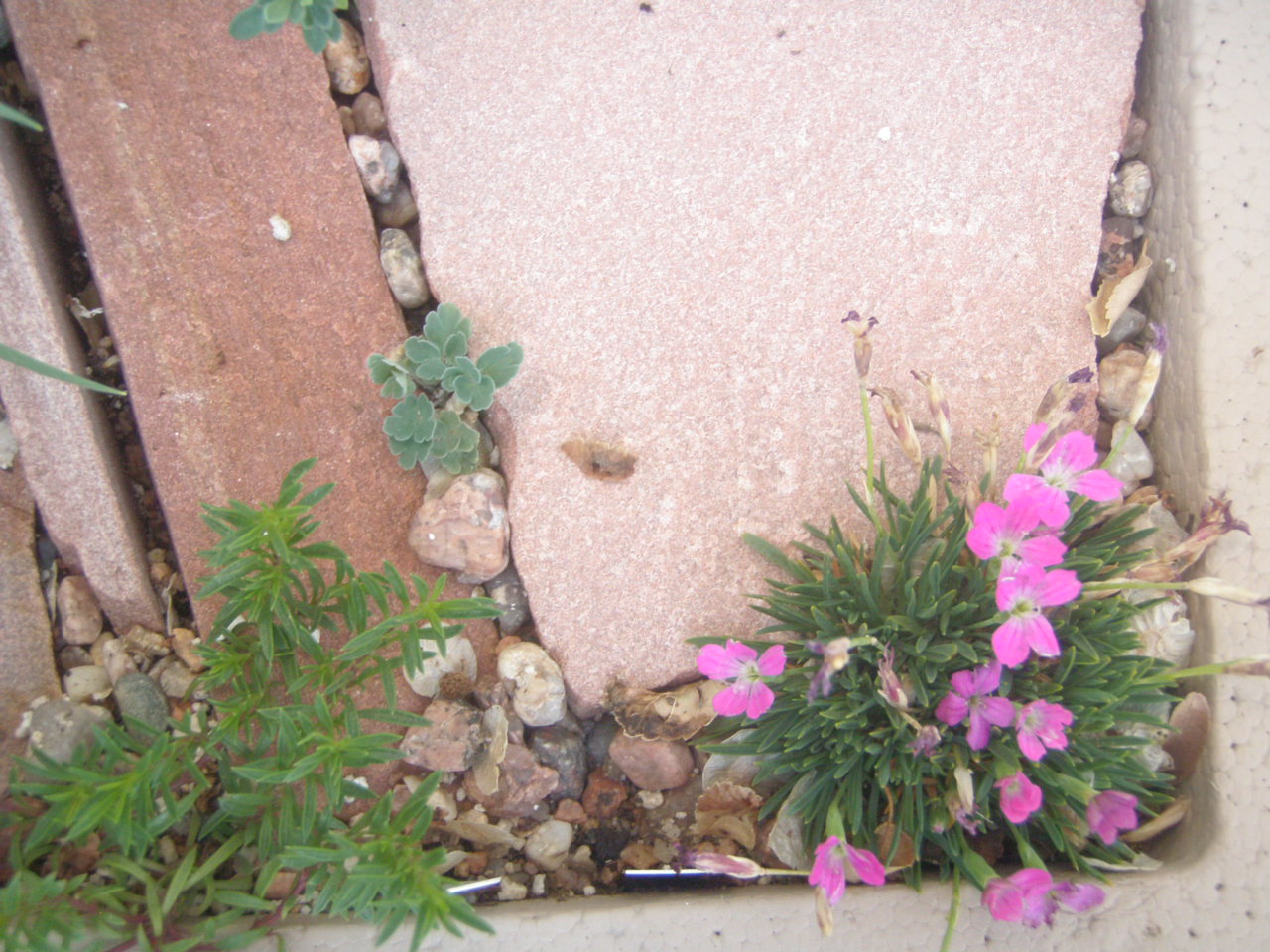
Until the temperature hit 100F (38C), and starting in March or April, this extra-cute Carnation has been in bloom.  It is not a desert plant, but is small enough that its water consumption is worth each draindrop-splash of pink.

Dianthus microlepis ssp. degenii

Friday, July 6, 2012

Hope


Despite the heat, the wind, the intermittent humidity, a trooper Gentiana (septemfida ssp.) grossheimii blooms today in its seed pot.

(Added later: -And continued to bloom {in the form of a single flower} for eight days.  I am humbled.)

FAIL


(Castilleja integra, Agave ovatifolia, the latter being a speicies discovered in Mexico within the past 30 years.)

Yes, I'm going to follow the post "Done" with "Fail."  An epic fail, as we youngsters like to say while we watch videos of skateboarders waving at the camera only to wrap themselves under prior-unseen wires or fences in comical ways.  Done and Fail: Two consecutive evaluations of the same thing- this Desert Crevice Garden.

There were certain mistakes I knew I was making, and decided for one bad reason or another justification, to execute them anyway. Now, I will admit them and regret them as well as document prior-unforeseen problems.

Don't get me wrong- I still like this heap of rocks enough to keep it,  but I don't think it is a shining example of a job well done; it is a shining lesson.


I still feel it looks good form this angle; the rocks agree and seem to be cohesive.


Fail #1 But gah!  from this angle, from the South, angles are not terribly in agreement, and that pale medium-sized rock in the middle has a terrible forty-five degree angle that is the most dissonant of them all.  Rocks in outcroppings in nature were once the same rock, so fissures make lines that repeat, and repeat, and repeat...
Fail #1.5: the above rocks also do not quite harmonise due to the fact that, despite my menteally labelling them all as "sandstone" and assuming they would thus be good bedfellows, they are different kinds of sandstone and are different colours, which immediately proves they did not erode from the same stone.  Epic fail!


(clockwise from top left: Echinocereus trigloch. inermis, Penstemon caespitosus ex Rio Blanco Co, Lepidium nanum, Leptodactylon watsonii, and Echinocereus morricalli x scheeri) 

 Now, the plants don't seem to mind, in fact, I am shocked how well they are thriving and already growing amid days upon days over 100 F (37C), with wind, even.  They are being watered lightly once or twice a week between natural baking cycles. The soil is unamended (no organics added) sandy-loam soil with bits of gravel mixed in here-and-there accidentally.  The surface inch, two, or three become completely dry, while moisture down deep seems to remain solidly.  Having no potting soil near the roots of these new plants seem to remove interference of the passage of this moisture up to the plants.  In driest times, they will wilt rather than outright flash-die like the average recently-planted flower.  This part has been one of the most persuasive observations that has convinced me of the miracles of the bare-root-planting technique. Amen!


Fail #2. And this section- what was I thinking?  I was on a roll to use up all stone I had nearby.  But tho middle section of the garden, with its paver-style sharp-edged stones, looks completely wrong between great moundy wind-scoured looking features and stones that are the rest of the garden.  It might have been fine alone, or within a whole garden with this more sliced-style.

Fail #3 Along the incredibly classy vinyl fence in the picture, the viewer will also see turf.  This is not a good thing.  A running perennial sod-grass with long rhizomes: it invades under the fence from the neighbor's turf. I thought about this problem early on, but all reason was subsumed by my impatience and that foolish tendency to do the fun bits and pretend that the less-fun bits (like installing edging to prevent the delicate and petite garden from being overtaken by horrendous brute hordes) can be conveniently forgotten.
WRONG!
Worse yet, I conveniently forgot there was a colony of bindweed, too.  Nice.

Thank goodness these neighbours are kind folk- for I have permission to install that much-needed edging on their side of the fence. (Since where the edging ought to be is completely inaccessible under tons of rock!)  I shall also have to spray or dig-pull-dig-pull remaining rhizomes that are already at home among the sandstone boulders.

Fail #4.  Washout!  Simple physics.  Certain areas (bear with me now, for verbose conceptualities) that see water-drainage from large rock surfaces get enough water flowing over them to wash the soil away.  It is usually crevices- cracks between rocks- that I see as prime plant real-estate and water sees as fair game to wash away.  Severity of washout exaserbates with the increase in size of "watershed" areas and decrease in size of soil-patch (relative to a soul-patch, and equally awkward) that must endure this tiny flash flood.  Indeed, rain or irrigation will accumulate on these spaces, funneling more water to special plants growing here (while they still enjoy perfect crown drainage keeping their little necks quite dry and free from rot), but before said hypothetical plant's roots can hold the soil, it seems to wash away.

Solutions: 
A. Don't forget smaller stones graduating down form the big ones.  Slivers that fit in to cover more of the ever-shrinking surface area in these crannies. 

B. Gravel mixed into the soil- more on the surface and less down deeper- seems to work.  I don't quite know why.  But in a tiny crack, I can see why: a stone will wedge itself with the steady help of good old gravity, and it is quite like a strong person who pushes his arms out to brace himself in a door jamb and tuhs keeps his followers from passing.

C.  Water tediously slowly.  This is what I did.  Shove a plant, like an 8-year-old-boy into full-sized knight's armour, in a crack and charge it with growing roots and leaf that will physically hold the soil in and physically slow down the passing water rivulet.  Then, water-in said plant with a drip-drip-drip speed.  A slow slow soaking will allow the soil time to soak in the water before it can form sheets which will roll over it and carry things off.  This is mostly what I did, and much to my surprise, steep inclines of loose soil got themselves settled in (the particles must become more locked together, I reckon) and appear to be resisting surface washout.  Perhaps the loam component of the sandy-loam is gluing together a soil "crust," which I have noticed when digging about lately.

What does nature have going on in her washout-prone crevices?  Lots of things, and they all seem to work.  Sometimes nature has permanent washouts.  But observe this one- nature can, in fact, fill up crevices.  Even ones taller than surrounding area.  Usually it is wind that accumulated this debris, and things that can get wedged will get wedged, and gypsy debris finds another spot.  But one fitting pebble stops another pebble, which in turn stops a pinch of sand... Also: Plants, attracted to the moisture or protection of a crevice whose soil has obeyed gravity (has leveled or washed away), will grow there, die there, accumulating particles in life and death. Their wedged-in carcasses will build up the crevice's substrate, whiel dead roots will hold in what is there already to accommodate yet more life down the road.
 This is already happening in  the garden.  The "carcass' part, too.