Friday, May 16, 2014

Public Service #7: A plant-list for Aspen

You well know those lectures where the speaker talks fast and slides stream by fast enough that by the time you've fallen in love with a plant and wiped the drool from your chin, you've not had time to take the name down.  Well, it happens to me all the time at least.  That is what this post is for- a list of the plant names, most important notes, and sources to acquire them.

This is a plant-list for attendees of the most recent lecture as of this morning:  Must-Have Xeric plants for the Roaring Fork Valley, (Which is Aspen, Basalt, and friends) hosted by the Center for Resource Conservation and the City of Aspen. (Thanks, ladies)

Thanks to all who attended, you were a riotous crowd.  I'm suprised they didn't kick us out of the library.

Pediocactus simpsonii,  the Mountain-Ball Cactus


Trees
Bristlecone pine: Pinus aristata
Wasatch/Bigtooth Maple: Acer grandidentatum

Shrubs
Golden Clove Currant: Ribes Aureum  {Sun/Shade. dry/moist}
Manzanitas!: Arctostaphylos x coloradoensis (example: "Panchito.") and A. patula {part sun/part dry}
Mahonia repens: CO native Oregon-grape  {Dry dry shade or sun.}
Curl-leaf Mountain Mahogany: Cercocarpus ledifolius  {snow-tough}
Mormon-tea: Ephedra viridis (Native green), Ephedra equisetina (Chinese blue), Ephedra  minima (Mini Tibetan)

Flowers
Pasque-Flowers: Pulsatilla vulgaris of Europe of P. patens of Colorado (example: Minturn, Boulder…)
Sufur-flower: Eriogonum umbellatum
Erigeron: All the Flea-banes...
Sun-daisy, Perky-Sue: Hymenoxys scaposa or H. caespitosa.  {Sun, med-dry} tireless bloom
Creeping Penstemons:  P. caespitosa, procumbens {of Crested Butte}, and P. crandallii.
Penstemons for Shade:  P. proceras and especially P. virens.
Viola corsica (Corsican Violet) {Shade. sun, moist-med-dryish, edible flowers}
Spurges: Euphorbia sp.  Elk and deerproof, but poisonous...
Artemisia sp.  Animal resistant, naitves are generally very dry.  
Lamb's ear: Stachys byzantina.  Sun/part-shade, animal resistant.
Humminbird trumpets:  Zauschneria sp.  {reblooming, SUN}
Globe-Mallow or Cowboy's delight:  Sphaeralcea coccinea. {Spreads, very dry.  Sun} S. monroana is bigger, not-spreading, and does rebloom.


Oddballs
Echium sp.  "Red Feathers."  Butterfly magnets, long-bloomers.
Thermopsis: Native or not: Golden-banners.  Tough, clumping, the native is aggressive.
Bukiniczia cabulica: A bienniel; order seed; It comes from either Mars or a Pakistani glacier!
Paintbrushes… Castilleja integra is easiest to establish.  Sow seed on disturbed, new soils and say a prayer.

Bulbs (Xeric by means of sleeping through summer)[available from Brent & Becky's Bulbs]
Wee blue things: Scilla/Chionodoxa/Puschkinia
Fritillaria: oftenlbs]
The heavenly snowdrops: Galanthus sp.  Why the heck does everyoen grow these!!!
"Species" or "Botanical" Tulips.  T. sylvestris, T. linifolia, T. tarda, T. dasystemon.

Grasses
Blue gramma: Boutelous gracilis.  Toothbrushy eyelashes.  Dry dry.
Lil'Bluestem: Schizachyrium scoparium.  Joseph's-technicolor-nothing compared to this.  Sun.

Cacti&Succulents
Sempervivums and Sedums- collect them all & try new flavors!
Sedum rupestre 'Angelina' is a classic, psychedellic "gateway succulent"
Flameflower: Talinum calycinum and friends.
Snowball Cactus: Escobaria sneedii/leei
Mountain-Ball cactus. Native basketball-sized.
Fragile Prickly-Pear or Potato Cactus.

Sources:
coldhardycactus.com
Timberline Gardens: Arvada, CO
Planted Earth: Carbondale, CO
Brent and Becky's Bulbs (VA mailorder/internet)
Chelsea Nursery, Clifton (Grand Junction), CO
LaPorte Ave. Nursery: Ft. Collins (Online or wholesale)
Sunscapes Rare Plant Nursery: Pueblo, CO (Online or wholelsale)
Alplains (Online or paper catalogue of seeds)
Western Native Seed (Online)


Monday, May 5, 2014

Spring's a-rockin' along...

Those of us in the "green industry" are really too busy to be online.  Too few daylight hours exist as it is.  And out there in the real world, this spring brings new fun developments in everyone's gardens.  Like some respectable growth on more architectural oddities like Shepherdia rotundifolia, Frankenia jamesii.

Castilleja integra flowers loudly echo the new spines of Agave utahensis var. kaibabensis.

And, a first for me, blooms on Castiellja sessiliflora, bought from Sunscapes rare plant nursery last year.


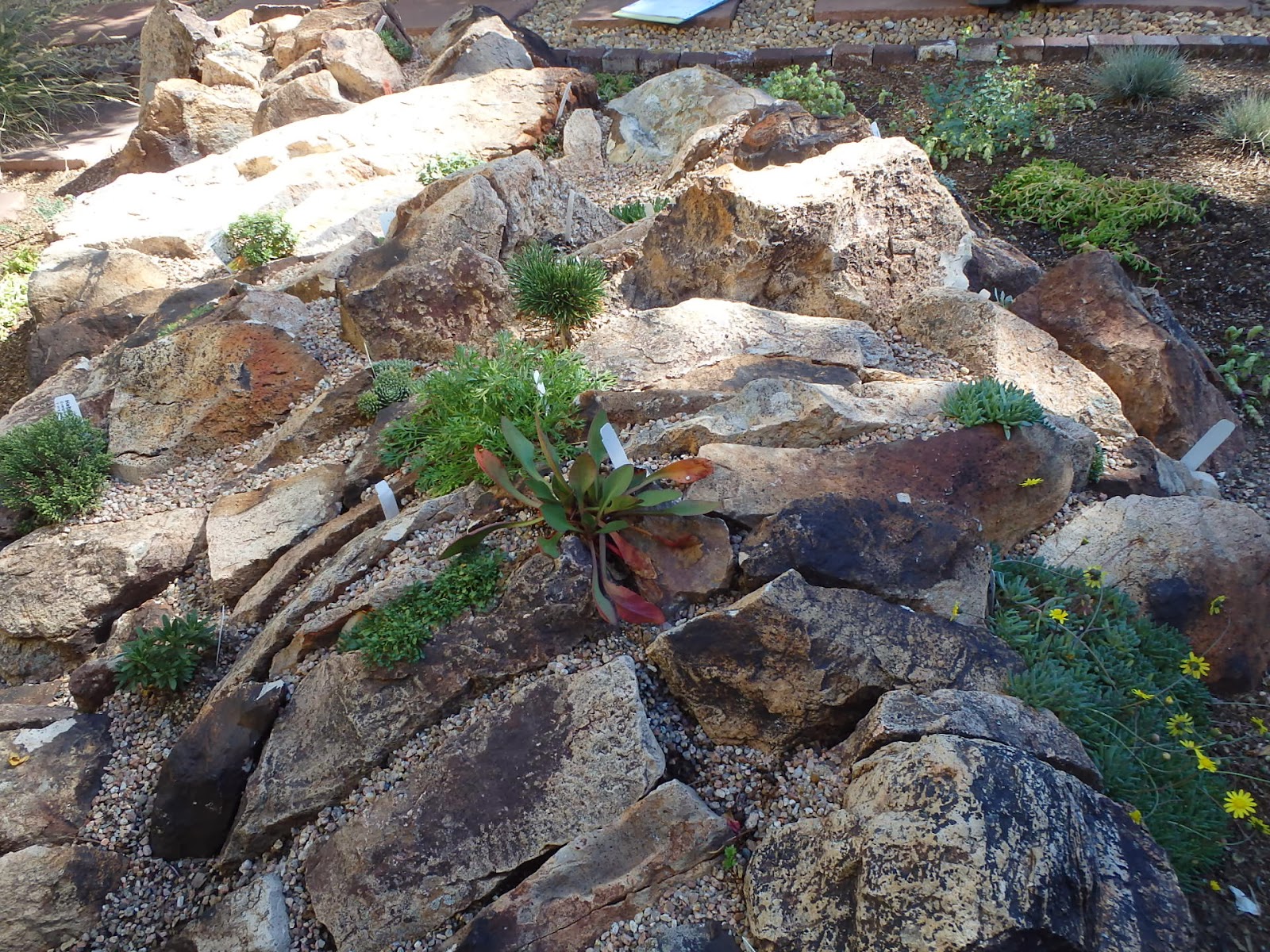
Here's what I've been busy with.  A 5.5 ton "granite" (Amphibolite) rockery for my friend Jan in Ft. Collins.  My envy is as heavy as the stone.  It was fun to make, but I am totalyl deprived the most fun part:  planting.

Jan will execute that herself with stunning artisticality, I am sure.  When they are new, a crevice garden looks like a bare sore on the landscape, just calling, howling to have plants in it.  I feel the void that nature must ache from until the gardener breaks out the dandelion-digger (now rockery-planter) and flats of rock-garden plants.

That's it.  It's gone too far.  I can't even count sheep when I'm in bed
(or walking through Timberline Gardens) without seeing crevice gardens.  


March saw the building of what I am trying to name "Mt. Shinn."  
Both Jan's and the above Carol & Randy Shinn's rock gardens will be in the RMC-NARGS rock garden tour this year.  you'll just have to go yourself to see the rest of their glorious gardens, the older and established and more colourful bits.

Carol has done some exquisitely tight planting already in the crevices.  

I finally got to visit Ft. Collins' Gardens at Sping Creek and their hidden-jewel of a rock garden.  The designer of this garden, too, will have her home garden on tour with RMC-NARGS.  Just a black-and-white photo I saw of it was irrepressably beautiful.  I was impressed with their blooming Helichrysum mats and some large specimens of Petunia patagonica. Those are some world-class Kew-botanic-level species.  At least, I don't do very well with them...

 A small crevice garden is underway at Timberline in Arvada outside their schoolhouse, where they hold classes, which have been so popular this year that the classes have been filling up to capacity.  Maybe a rough winter left us all completely mad to scratch that green itch?


Lastly:  Sand.

In more techincal notes, the "X" section at the end of the paper, if you will: the most recent crevice gardens have been using sand as their main media component.  This is a swing back to the traditional Czech approach.  Generally, these crevice gardens have been built on top of a clay-based Colorado soil, which, underneath this rock-paved mound of sand,  must remain significatly moist and cool.  Think of the garden as a very convoluted multi-layer mulch/topdressing if you will.  The surface absorbs the water incredibly rapidly, but the the deeper layer may never even dry out. This leaves the plants with options as to where they want their roots…

Sand has meant several things.
1. It is easy to work with during construction.
2. It absolutely must be top-dressed and hidden with gravel to prevent it from washing away during rain or irrigating.
3. It settles quite significantly. My hero, Zdeněk Zvolánek, writes about carefully packing, tamping, and teasing the sand under and in-between the stones during construction.  I've found that impossible- perhaps from my youthful lack of attention span or my frenetic buidling process- to execute to the point that the sand doesn't settle afterwords. (Or maybe its the kind of sand?)  It seems that within a month or two the majority of settling happens, and I am guessing that after one full year it is practically done settling, but time will tell.  Those particularly novel and artsy-farsty crevices can settle immensely and require back-filling after a month or two.  I think the patience is worth it to wait, then refill that crevice with sand and gravel, topdress with gravel, and jam a plant on it for what must be seen as a posh high-rise dwelling for beloved plants.

On recommendation of our friend Stephanie Ferguson in Calgary, occasionally I've mixed the sand with equal parts sharp (as opposed to round/ peagravel)  gravel.  It may stabilize the sand in precarious positions.

Sand-beds are not unheard of in rock garden circles around the world.  Many plants love ot grow in it, lacking traditional organic sources of nutrition, but supplying subtle mineral nutrition. This rock garden is essentially a sandbed whose gravel topdressing is mega-sized into 800-pound stones.

Are you wondering how well it works?
So am I.
Stay tuned.

Thursday, February 20, 2014

My Big, Fat Czech Crevice

"Crevice garden? It never ceases to sound dirty," my best friend says.  Constantly.
And it is.
Deleriously dirty.


Here is a post to simply put more Crevice Garden pictures on the internet.


Mike Kintgen's recent crevice feature in the Mordecai Children's Garden at Denver Botanic.  This makes my heart flutter; his best work yet, I think. The plants are literally eating it up.

 Then, I hazard to follow that up with my main dry sandstone crevice garden, in full-frontal, unflattering view, car bumper, vinyl fence, and all.


Last summer, I built one at my apartment.  All you really have to do is group a few similar stones closely together. (Well, there is more: stuff the cracks with something drainy like sand or sandy-loam, or sand and gravel mixed. Then top it off with some gravel/chips/small stones to completely cover the soil)


I already regret it.  Eh, it's just tolerable.
{It could be much, much better}


Perhaps a better garden, and definitely a better gardener, Lee Ann Huntington has done such nice things with plants in-between the rocks I set.  Checking in during the summer with this garden since its birth in spring, we see she has every right to be proud of that Lewisia tweedyi!


And Anita Cox's garden wins the award for filling-in and looking mature within the first year.  She has some kind of magic touch.


And then the news. The new News.
Stephanie Ferguson, Crevice-gardener extraordinaire of Calgary, AB, Canada, came to give a talk to Denver's Rock Garden Society last fall. We were blown away. I clung to her every word. But Linda- oh, poor Linda: She was closest to ground zero by hosting Stephanie at her home, and Linda's own desire for a larger crevice garden exploded under the intense pressure, and with all that perfect autumn weather we had last fall, we built her very own four-ton smart-car-sized Plant-growing machine:

Nearly done...

First plants are going in before the gravel topdressing.

The backside of the crevice garden becomes a slope of open soil to accomodate dwarf conifers and bigger herbaceous perennials.

From the front.  These 3-D things really don't photograph, admittedly.  I'll keep trying.  

(Photo courtesy of Linda Meyer) 

She had a bit of fun planting.

(Another photo courtesy of Linda Meyer) 

OK, a lot of fun.


(Yep, three pictures from our girl)  

No, she went wild!  And it looks great.  Lastly, it has received a grey gravel topdressing, (not shown here) which should be noted as an essential ingredient to this whole Crevice-Garden thing.


But wait, there's more!
Three Crevice Troughs/Pots.
An impeccablely artistic trough by Tony Stireman in Salt Lake City, UT.
Note the extreme topography he has achieved- soaring high over the rim of the pot. And the very happy plants.

My cheap imitation which, despite being of 100% trashcan-sourced materials, and thereby escaping the category of "cheap" with its actual negative material value, excels at growing things that I can't grow anywhere else.

An bonsai-referencing mini-crevice pan by my friend.


(Pediocactus simpsonii in the CSU extension garden, Grand Junction, CO, USA)

I'm telling you.  
They (plants) love it.


So, truly lastly, a self-help-flavoured effort to blackmail myself to expedite the process: the blank canvas at my parent's home which promises to become, this spring, a quite large grey-granite crevice garden.
Here's the spots(s).

Here's the stone.


Happy early-early-early spring, my friends.

Wednesday, February 19, 2014

More. Tree. Types: Tree Diversity Conference 2014

Are you interested in biodiversity in our city trees?
Well, the well-reported emerald ash-borer threatens our cooling urban canopy.
But what can be done?

I love when "biodiversity" is the answer.

A quick announcement and plug for a tree conference. It's a Friday full of lectures from people who know more about it that perhaps anyone else.  These folks are really the creme de la creme of  tree fanatics in America.
It's going to be a smallish thing, so $60 is a steal to learn from these unmatchable individuals and rub shoulders with them.

Click for details:
Tree Diversity Conference 2014, at the University of Denver 


Hey- I'm going for the food.


Beware of Existential-crisis-bearing Passionvines.


Passiflora x 'Sunburst' 

A tiny mail-ordered Passionvine arrived last winter carrying more than a plant tag and a packing slip.  I'll not mention the company's name, since they did, in fact, send a live bug with this vine, which is practically wrong, but turned out to be novel fun.  Or potentially philosophically depressing.

Quickly, about the vine: It is a hybrid of two tiny tropical species of passionvine. It bears inch-wide turpentine-fragranced flowers over wildly-shaped purple-backed spotted leaves. It's a windowsill novelty for people who suffer chrinic novelty-osis.

The bug: a green larvae.  Since it was on a passionvine, I imagined it might become a Longwing Butterfly.  We'd see.  Larvae consume a great deal of leafy material to grow up, and that twig of a baby vine would not be enough- on top of which, that would be twenty-five dollars and ninety-five cents worth of insufficient bug food instead of pretty flowers.  

But, as luck would have it, I had a fat mason-jar full of Passiflora x 'Clear Sky' cuttings on my kitchen table from my parent's garden. (This is a hardy German hybrid- it can be grown outdoors in a fertile, watered, climber-friendly warm position.)  These leaves were plentiful and gastronomically compatible.

(The monster flowers of the tropical-looking Passiflora x 'Clear Sky' bred by one Roland Fischer, on a fence in my Parent's Garden)


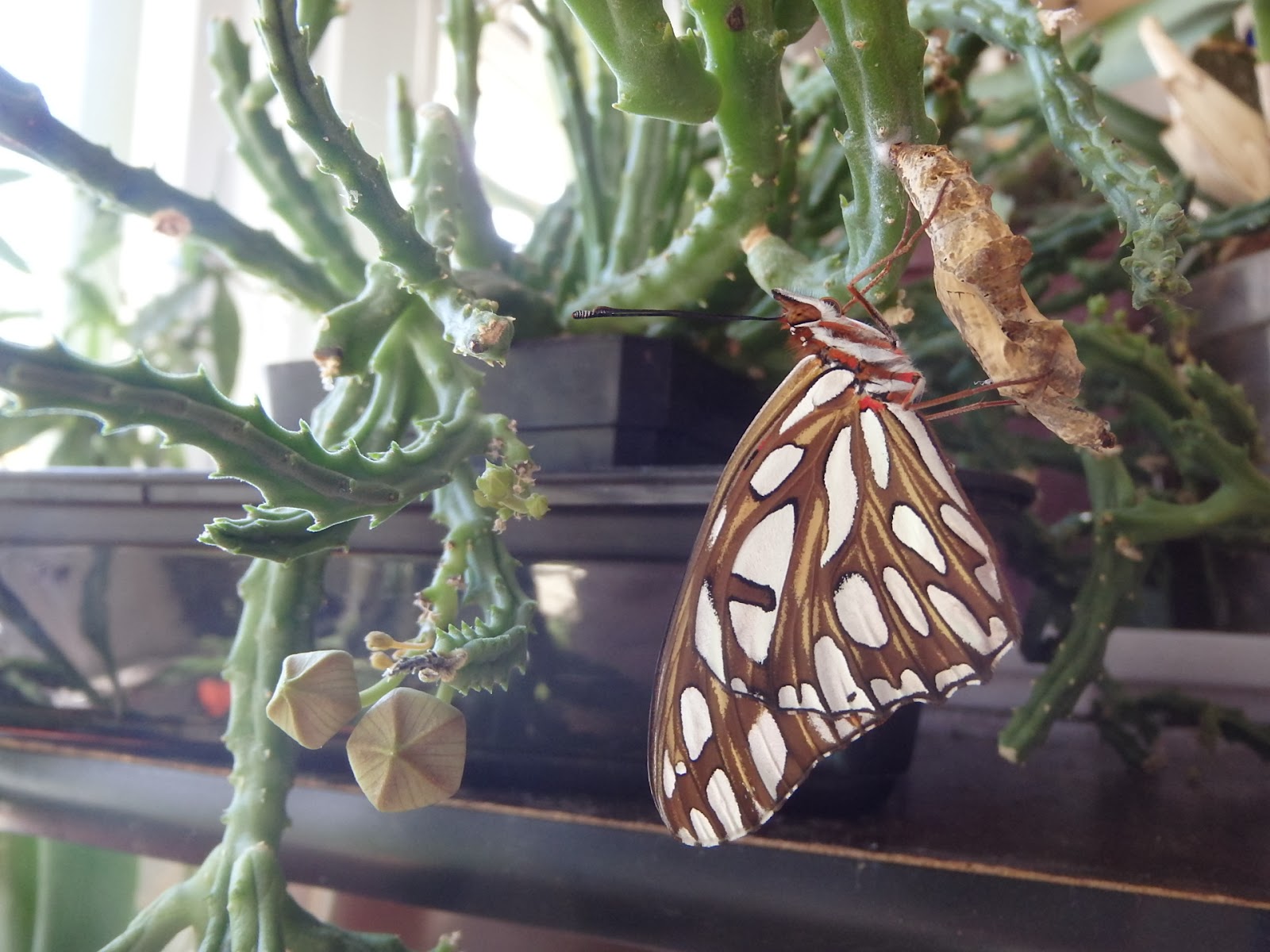
Anyhow, while I was out of town, the little bugger ate its fill of Passionvine cuttings, undocumented by my camera, and promptly pupated; attaching its butt to a Stapelia plant in the windowsill.

Do you see it? It's brown.  How fun the chrystalis/pupa curves the same way as the Stapelia sticula branches. And it sat. Changing quietly.  Or wiggling wildy when budged. Butterfly pupae do this.

'Ere she came, one fine morning, when, of course, I was headed out of town again.  It was also the middle of November; no time for a butterfly, who really barely belongs in Colorado at all.  

But we enjoyed this creature immensely and the few weeks it lived in the kitchen.
Gulf Fritillary, or Agraulis vanillae.

The spots on the undersides are somewhere in between reflective and opalescent.  This bug was fortunate, at least, I suppose, to have two plants in bloom from which to feed in the kitchen. (I never saw it actually consume anything.) -The only place it would ever be as an adult. 

I'll let you think about the point of life when, like the butterfly's,  was full of destiny (hey- I dind't squish it and I happened to have the exact exotic plant to feed it) is ideal (lacking predators), is more celebrated and observed than most others of its kind (you are participating in this truth) , but lonely, contained, and never procreating…


I'd like to think it's not so bad.

Pan's Gardens: Boulder Garden-scaper Rockstars


Our dashing GQ cover-boys, looking very sultry.

Meet Ryan Durfee and Paul Montgomery of Pan's Gardens, Boulder, Colorado, USA.
Last October I took an opportunity to work for a week for these fellas to see just how they do business, taking those lessons home to my nacent new business.  Or maybe I worked for them to assimilate thier swagger.  There's a good chance of that.

 
I need some rockin' door stickers like theirs.


Pan's is an organic company.  You've read about solarizing lawns to kill them (as opposed to hosing them with poison), now you can see it in action.  Paul and Ryan offer some incredibly efficient, tidy, and detail-oriented and mainenence service, as well as earth-conciouse installations.  The above has become a "Peasant's Garden," utilising native shrubs, if I'm not mistaken.

Pan's Gardens is bravely going places that so many are only talking about- here is a meadow-style strip recently established.  Look out for Meadows in cutting-edge progressive landscapes in future.  Folks like Ryan and Paul are bearing the weight of inventing the wheel we'll all be riding and taking for granted in future.  Read about thier philosophy and drink in their work: their website is weird inasmuch that it is not painfully commercial, but fun to peruse.


Ryan shows me his recent xeric installation, featuring maximum biodiversity in a small space, which means there are a dozen things in bloom, even among young plants, in October.


 It wasn't all work and drinking espresso- we cruised gardens and looked for green trouble on the streets of fair Boulder.  We even found a greenroof, and upon knocking on the front door of the house on which it grew, we found that I had consulted these folks and sold them the first plants for their roof some years ago. What fun to see how my suggestions did or didn't work.   The owner let us waddle around and have a malenky bit of a look-see.
This is us on the roof: note the refleciton of the second-storey-neighbour!

Private greenroof in Boulder, CO, excecuted by its enterprising owners. (Not to mention a frugging fantastic rock garden!)


I'll take this line to thank Paul and Ryan, as well as Ryan's family, for tolerating and kindly accomodating me.  

They do look after some beautiful places.