Tuesday, March 13, 2012

Done.


(overlook near the San Rafael Swell, Utah)


Well, not really. at all. Far from it. But the stones are in. For now. As a friend points out, rock work, even, is nothing that cannot be taken back. And as fickle as I am, some probably will. But I want to move on to new projects. The bow-tying of a current project enables dreams to be unwrapped into new fun projects.

It's about 21 by 7 feet, skinny going North and South.


I didn't steal the BLM sign- It's a habit to pick up non-natural debris like candy wrappers, water bottles, and even fragments of shattered fibreglass trail-signs from otherwise pristine places.


And perhaps in the worst place aesthetically, but the only place it could be practically. There is no other site sunny enough on my parent's property as here, set off by the garish white of vinyl, and parked next to a dirt driveway. And so, there is no more respectable place to set a prized rockery than in front of where trash cans often majestically stand, and behind a scenic mailbox. Alas- I'd like to think that the more challenges make for the more interesting solutions. I'd like to think.


Anyhow, important things to know are this- the sandstone, like an underpainting is "keyed" to be of similar make and colour- trying to make the rocks not stand out from one another. To keep them low profile, like one burnt-sienna stroke next to another. Nothing too exciting-feeling yet; I want the plants to be the exciting bits. The stone supplies the form (shape in 3-D terms), and plants should supply texture, colour, and yipee. (another technical term).
The goal is to leave the composition unfinished, welcoming the plants as the centrepoints and not distracting from them.


Art point number two: the vinyl fence is not my cup of tea; but it is there. It is a strongly contrasting white shape, almost a line, horizontal- and so I will break up that line with other lines- desert shrubs- growing vertically and effectively bisecting its strength by bisecting its length.


What follows is my natural bibliography- moments in nature this winter from the desert wilderness that are quoted in the rock garden:
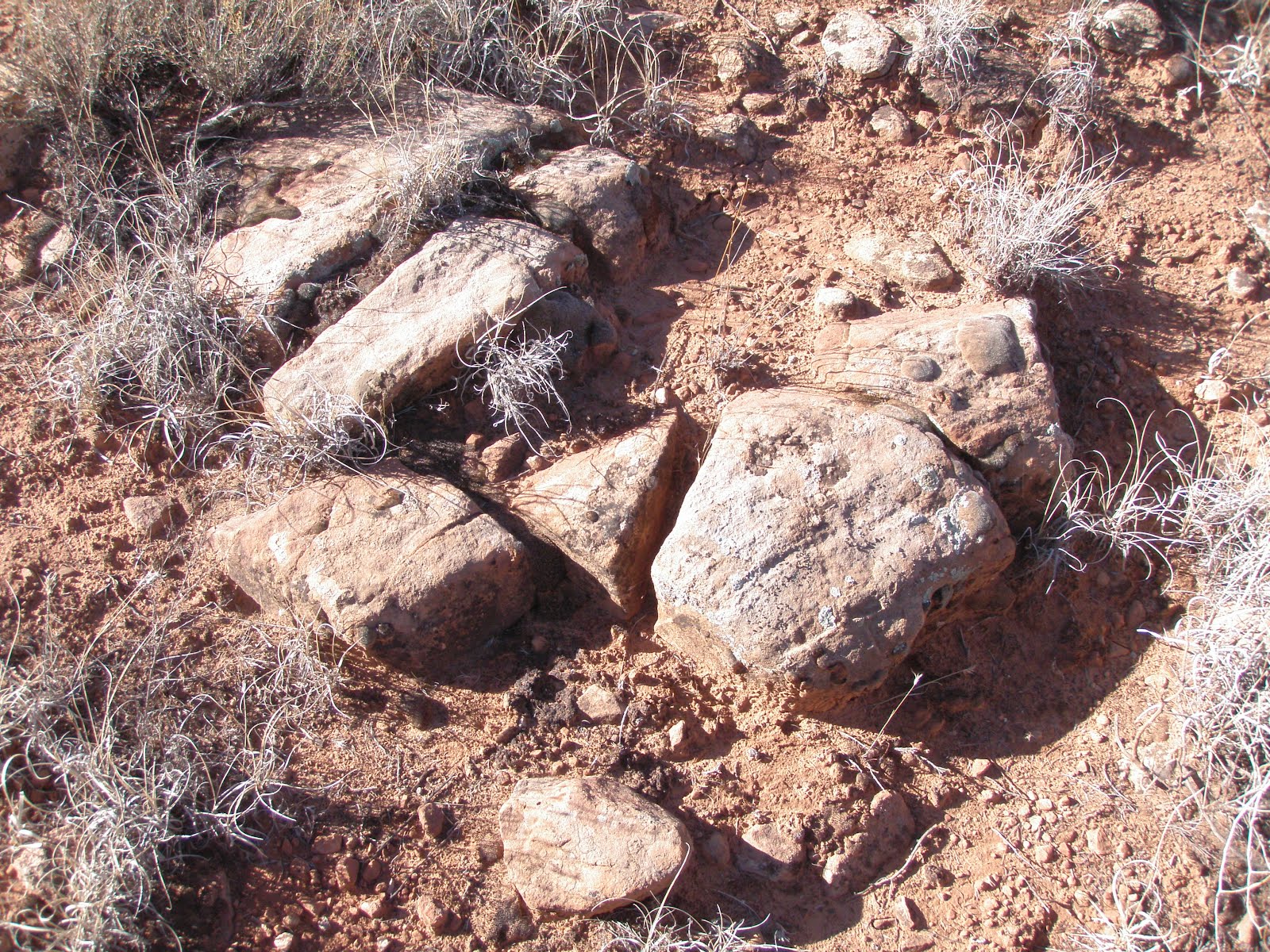

(West of Zion National Park, Utah)


(Near the Gunnison River Bluffs, south of Grand Junction, CO)


(Dominguez Canyon: Yucca harrimaniae)

(Zion National Park: Shepherdia rotundifolia, an evergreen desert olive. Glorious....)

Tuesday, February 28, 2012

Mid-rock Mess


Thinking outside the rocks.

About five tons of sandstone lies there, two yards of sandy loam, and two finished sections looking like book-ends with a hollow middle. For planting purposes, I need more open soil in the middle, but perhaps above all, my back is getting tired of hauling-in 700-pound and more stones. It doesn't fit with my original sketches, which called for nearly solid stone the whole length of this skinny rockery, but perhaps challenges have forced me to think outside the rocks- to embrace and develop that kind of space that is between no-rock and solid-rock. I have favoured the latter for a while, but now I am forced to engage that aesthetic and composition that I've been avoiding. True, it is the kind of partly-stoned space that most rock gardens have (and only that), for one reason or another.

Maybe it's like turning one's nose up at a cliche, but being forced to admit that there are merits and reason the cliche is so alive...

So here's to a moderate spreading of the butter of cliche on the bread of life. Because I really need some room for mesembs.


Personal note: A good day in the canyons this winter convinced be to moved back to the Western Slope of Colorado; where I find myself under the rule of relentless blessings- a sunny Victorian Downtown flat above a 18x40 veg garden, and working for my favourite and the only native specialty in the valley- Chelsea Nursery.


Wednesday, September 28, 2011

Crawling Creatures of Autumn Delight


This post is about low things or great autumn things, and things that are both.
The fetching Townsendia incana, in the Colorado National Monument, in spring. A low plant needing more attention from dry gardeners. Usually found in a few places here-and-there in the Monument, it is having a field day this year and is growing everywhere, probably to blooming its head off in a favourable year for it to resign to a quiet, invisible presence in the wild seed banks.

I really have got a hobby horse about this native roughneck. Distichlis stricta (aka Distichlis spicata ssp. stricta) It is an agressive underground-running sod former who should be used in places just like this spot above- unirrigated and divided from other cultivated beds. In the right place, it could be one of the most useful groundcovers. Pity it is not available. Note how it is crowding off the Weeds to the bottom right, (perhaps Lamb's Quarter and Puncturevine/Goathead: Atriplex hortensis and Tribulus terrestris respectively). It appears to also be left unmowed. I personally like the blonde look it takes on upon cold weather.

Another sod-former often growing alongside the above Inland Saltgrass and acting much the same, this is scratchgrass, or Muhlenbergia asperifolia. The left side has had a mower take out that pink-ground-cloud-of-glory. Fruita, Colorado.
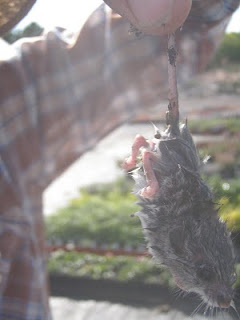
Some ground-dwelling fauna to spice it up. I caught this fella by cornering him with a watering wand in our growing field at the nursery. It was nice to personally meet the enterprising fellow who will excavate and destroy the roots of a speckling of plants in their containers. I thought he might be our usual suspect, a vole, but he looks more mousy.

Little Bluestem at its most colourful. I invite the reader to count and note how many entirely different and un-subtle colours there are. The plant will all go to a pinky/rusty/ruddy colour in a few weeks, which is how it will remain all winter until new, blue or purple stems grow in late spring.
The same colours in a sunset. Nature has agreed on an autumn palette, I see.

Thursday, August 25, 2011

New Desert Crevice Garden

In a brief visit back to Grand Junction, I built a small experimental rockery. Using local stone and inspired by local formations. It is basically a re-build of an accidental miniature rock garden that accidentally succeeded in that location.
This is one of my favourite natural sandstone outcrops near town, halfway up Mt. Garfield. Note the interaction of soil and rock, and location of plants. Naturally artistically composed.
I love this look.
Natural desert Crevice Garden. Hedgehog/Claret Cup Cactus (Echinocereus triglochidiatus) Somewhere near the mouth of Ute Canyon. I think this proves that a desert crevice garden is feasible. Those cactus seem to be liking where they live.
A view from the street. There are extraneous temporary rocks on either end that are intended to keep frequent neighbourhood dogs from trampling surrounding plants when they are young; but they will stand on their own once established. I assumed this was no great place for a rock garden until I realised that flowers had indeed succeeded there, much by accident, as the tree matured and shaded more of the area. It does get full hot south sun in spring and fall, as well as some four-plus hours each afternoon. This was enough to grow some old Veronica, emaciated Zauschneria, a colony of Fritillaria uva-vulpis and a Helianthemum in dry shade in clay. Often, I think that stressful dryness keeps otherwise sun-loving plants from becoming leggy and tender in the shade.

Only one wheelbarrow of soil was added for height, and as one can see, it is rock-intensive; in the style trying to appear as an eroded outcropping. Stones divert water to the cracks between, where it is trapped and cooled under the stones. Young plants are forced to grow deep roots to bypass the stones before they spread out and will likely subtend and embrace the bottoms of said stones.

Artistically, drab sandstone was chosen to reinforce that they are each simply components that form a whole, and are meant to be visually submissive to the interesting and often loudly spiky plants.

It is a small stretch of only some eight feet, and I fancy I shall add a couple outlying and small stones to make more unity between the rock mound and the flat surrounding soil itself. ( I also just picture another nice fat Rosemary just behind to give some taller shrubby mass to relate down to the rock mound...) I know that should the Agaves favour this position and grow into it, they will overwhelm and hide their nearest rocks, and that is just dandy! (note, too, that the blue monster to the left is not, indeed, the beastly noxious Myrtle Spurge, but the Mediterranean stiff spurge, Euphorbia rigida. It was planted in that corner this spring and was luxuriously successful, beckoning the construction of a larger rock feature)

Stay tuned to see how on earth one can relate and reconcile the divergent styles of an ivy-mulched (read: evergreen and lush-looking) dry-shade near-buried basalt-boulder rock-garden swath nearer the house with a grassy, sagey, sandstone rock garden. I myself shall be interested to see how it is done.

This rockery is actually just an outlier itself, and will compliment a larger rock garden across the driveway which is still under construction, which waits for the builder's energy to be enough to handle its several-hundred pound components once again.

And one last picture to justify my design!:


Somewhere near Monument Canyon, Mesa County. Maybe.

"Immature poets imitate, mature poets steal..."
T. S. Elliot, Maybe.

Monday, August 1, 2011

Happy Colorado Day; August First.

August 1
is the 135th Anniversary of Colorado joining the union as a State.
And what a fine state it is. 'Tis a privilege...
Corydalis aurea is a Colorado native yellow bleeding heart. I'm pretty charmed by them. (not too far from Fairplay, Colorado. )


Looking East from partway up the side of Mt. Sheridan, which is shoulder-to-shoulder with the more famous Mt. Sherman (a 14-er) to the North.

At the top of Mt. Sheridan before I did that thing that all mountaineering books spend their introductions warning you about: getting caught on a peak in an afternoon lighting storm. I often hope mother does not read this blog.
The treat of 12 thousand feet elevation: Alpine forget-me-not: Eritrichium aretioides.

Friday, April 22, 2011

Small and New Horizons

Expect to see more Nananthus transvaalensis in gardens and about in future. I am currently in love: I find that this one doesn't need fancy dinners out, cute chocolate/gifts, nor have I heard it ask to borrow one's letter-jacket. Just an occasional splash of water and well-drained soil.

New Digs: Pots for Hope

(As a short personal note: I have started work for the unsurpassed Timberline Gardens in Arvada, Colorado; managing perennials. I feel I should be given a degree after everything I'm learning from this work. I certainly have a better headache at the end of each day than all those times I "crammed" in college.)

My job at Timberline is gardening en masse, and all in pots- thousands of them. Keeping the plant ready to deliver to garden all over the front range and beyond.

My trouble at home is that I am not yet landed enough to have land.

A gardener finding himself maniacally without an actual garden, I have been humbled to explore the advantages and limitations of the humble pot. It is a great and terrible thing, keeping a plant in a container. While I suffer from my trials and error and error and error on my fine Balcony "Garden" with everything from peas to Cholla cactus, I want to share some pictures from around everywhere meant to inspire the user of the potted plant.

It's really all about the ground not being right (or maybe existent) for the plant, or the plant not being right for the ground (or hardy - like a tropical this-and-that in a cold-winter place). So we improvise, with pots.


The ingenious lemons-to-lemonade treatment of a broken terra cotta pot by a late Victorian Alpine Enthusiast.
A memory that inspires me perhaps more than any that I can indeed garden, even if my garden are spread far from my dwelling. This, above, is part of my buddy Zhiro's Tulip collection on top of his grand parent's garage roof in Armenia. (The white veil keeps extra-special plants protected from well-meaning bees who may carry virus.)


Even in the confines of a soilless courtyard-neighbourhood in Tbilisi, Republic of Georgia, a housewife has a tinket collection of doorstep plants.


Another one in Georgia- probably Batumi. Even I've fallen to the simple charms and promise of eternal flowering from a potted Zonal Geranium (Pelargonium)


Someone, or a couple someones, who have by far less balcony (and sunlight) than I do. Somewhere in London.


Home sweet boat. Nothing beats a fresh BLT. On the water. Lincoln, UK. I didn't check to see if it had an appropriate bumper sticker that read "My other boat is a bike."