Monday, September 9, 2013

Underappreciation files #4: Torrey's Mormon Tea


I collect mormon teas, aka joint firs.  Plants in the forty-some species-rich genus called "Ephedra" from  pretty much all the major dry places on earth.  From Patagonia to Mongolia to the Sahara Desert to Utah, USA. Look it up if you want to know about some species' medicinal properties and that history, it won't be covered here.

Wouldn't it be nice if there was a mormon tea/ joint fire species which never suckered? (The common green Ephedra viridis rarely rarely does, but it can...)  Wouldn't it be nice if it were a shorter, manageable size,  maybe blue or grey or silver instead of green and please- while we are asking- could it not only still be like the best of the Ephedras  which grow in perfect health and quality without irrigation- even in arid climates, and oh-yes, too, while we're at it, we want it to not mind ridiculously heavy clay; Bentonite clay, even.

Done, baby!

(pictured here with Opuntia fruit in foreground)


Enter Torrey's Mormon Tea.  Ephedra torreyana.

It's not a perfect swap, but it could replace the taller, (and more showy, fruit-wise) but potentially ravenously aggressive asian "Bluestem Joint Fir" (Ephedra equisetina) which is nicely common in the trade and eating the corner of a parking lot near you. It shouldn't be shunned, but deserves a place where it is allowed to run like a randy horse.

(Ephedra equisetina, playing the part of Hydra in the Odessey, gobbling up earth and growing back worse each time it's hacked)

Like many (if not most) Mormon Teas and no more than 99.7% of humans, Torrey's Mormon Tea plants are either male or female.  Their flowers get dangerously close to what one might call beautiful in the spring, and the female produces papery cones (as opposed to berry-like cones in other species) in early summer.

(Perfectly grown Ephedra torreyana from Chelsea's)

Problem: almost no one grows this.  That is to say, I think there is literally only one source to buy one on this fair glossy planet (aside from digging a wild one up, which is not recommended for either conservation nor practical reasons) :  Chelsea Nursery near Grand Junction.  I just bought a glorious-fat-healthy-#5-pot Ephedra torreyana from them to plant for a client this week; it did my heart good and got me thinking, with hands in dirt, that there was little info on this plant on the web.  Travesty.

I confess to allowing this underappreciation by not taking more pictures of it; I take it for granted.

A shaggy old wild plant.

Now, the fact that almost no one grows it can be amended easily, since I am pretty sure I collected a fair  full bag of seed this year that needs to find a nurseryman/woman who will convert it into a field of Torrey's Mormon Tea.

Let's poke holes in the curbs to let rain penetrate Box-store parking lots' grave-style shrub-medians and replace the unruly pissed-off Junipers with Ephedra torreyana, whose ultimate size would require less/no pruning.
How many megabajillions of gallons of water per year (that converts to money, dude) could be saved if we did that?

Eh, it's better not to think about it.
But rather to do something about it.


Public Service #5: The Olympic-Dive-Propagation of the Self-Cloning Native Gourd

Cucurbita foetidissima: Buffalo Gourd/Coyote Melon/Calabasilla.

It is well documented that this aggressive perennial native squash-vine can increase its numbers by layering (or "spreading" by "runners") of its long, above-ground stems.  Like a strawberry, but not really.  And meaner.

 Here are some pictures that betray how the plant seems to do this not accidentally (where the stem may touch the ground randomly) but deliberately:  the tip of its long stems make a very purposeful poke into the soil.  Note how this particular shoot's leaves are reduced and there is a nacent root forming before it has reached the actual soil.  I am not sure how the plant determines at what point these growth tips do this: after many feet (6-20' or more) of trailing along the ground like a great crazy snake, it moves in slow-motion-mimicry of a dolfin,  rearing up a bit only to point immediately downward and dive into the surface.

Boom.  More plants.


Here, the tip forces a root into the soil, and the tip turns upward again back to unfurl more leaves, and will form its own new perennial plant if there is enough time before the frost.  A little like a starfish, a little scary.  Brilliant self-cloning technique on behalf of this monster plant, considered a "weed" by some, and "just plain cool" by others that know there is a place for every plant.

Note the small white bump issuing from from bent-angle bit of the stem.


(Plant pictured is in the Cactus"Arboretum" of Timberline Gardens, Arvada.)

Monday, July 22, 2013

Crevice Garden Crazy

I hate cheesy puns in titles, and alliteration.  The tides of trend are strong.

Announcing a small outbreak of Crevice Gardens in Denver.  I think Mike Kintgen said he's put in five at Denver botanic Gardens to date (not just this year). It's a better way of growing plants.

(The Big Crevice Garden at the Entry to Denver Botanic's Rock Alpine Garden, in its second season, thriving. It makes a pretty solid arguement for Crevice Gardens.

(Crevice Trough by Mike Kintgen for Anita Cox)
A crevice trough is excellent for those who aren't ready to commit to a full one or have the space- I have several of these and the crevice environment benefits are the same as a "life size" one.

So far, it's the only way I've succeeded with plants like the Stemless Beardtongue (Penstemon acaulis) and the Rimrock Paintbrush (Castilleja scabrida).  {This one has clay in the crevices} 

I wanted to celebrate three which happened this spring, and make a nod to my friends who let me build them for them.  What they do with plants will be the real show and the great glory in future.  Each  one is so different and very individual: styles are extrapolated from personal preference, site, and existing garden/home.  Such parameters make building one possible.

Linda's vertical red sandstone garden:
She sought something highly dramatic that fits her style of house and garden.  Those highest and most vertical crevices will be harder to plant and maintain, (My go-to is small Sempervivums as pioneers) but they will be quite a statement.

From above.

Her garden is bright, bold, and playful.  It takes one a while to realise how small it is.  I hope the crevice garden does it justice.


Brand-spanking new, still covered in dust.  I can't wait to see how Linda has planted it.


The elegant Anita Cox (and estate supervisor Maggie) in front of her South-African Inspired Crevice-Garden.  She shared with me pictures from a trip she took to South Africa to inform the design.  Some of those stones were a beast to wedge and support into place, but deep and spacious crevices allow for shady, wind-protected spots.  It should be great for true alpines.  

Weighing in as the largest was Lee Ann Huntington's Rockery.  I particularly like how the rocks jump the path, or does the path bisect the outcrop, like a mini roadcut?

Just finished, mid spring.  I wish this were my Mesic rockery. Note the regular stratificaiton interrupted by the terminal face of the feature, a Czech Crevice Garden rule.

 Early summer, planted!  Photo Courtesy of Lee Ann herself.

She's aleady got a fine collection tucked into those hospitable places.  I'm finding that the tighter the spot, the closer to the meeting point of two rocks, the better the plants. Nice work, Lee Ann.

Each gardener was honoured to host a garden tour this spring, the first two by the  Rock Garden Club and the last by the Park Hill Garden Walk: so hopefully, tour-goers were introduced to the wonky and wonderful style of Crevice Gardens with these nacent ones.

Thanks all.


Saturday, July 13, 2013

One for the Bugs

This is one for the bugs.  A most springs has been good for insects, too.  In the past twoo weeks, bugs abound.A post to honour them.
Warning: Photos contain many shots of my unclothed left hand. This is for size.


A Mason Bee, (Osmia sp.)  tries very hard against slippery plastic to stuff "bedding" for its progeny in a screw-shaft.  Hey, it's easier than drilling your own hole.


An accidental hitchiker from a field collecting trip- the desert denizen, dweller-of-under-rocks, Jerusalem Cricket.


Bugs get big in the Desert.


A moth- note its very subtle forest-green flecking between the brown, the same hue as the plastic irrigaiton timer in my nursery.

Larvae of what must become a butterfly, chowing down on Paintbrush:  Castilleja chromosa, on the Uncompahgre plateau.


 Four "bugs" on one flower stalk.  Of the Mustard Dynasty, reigning over the June desert after a good rain, Prine's Plume (Stanley pinnata ) hosted ants who were harvesting nectar from the flowers. (A parastic wasp just crashed into my coffeecup as I write this, and flew away)  I moved in to Poke at a Flower-Spider, clad in the same yellow as the flower and totally invisable.  But note how some buds did not open, but are swelling obesely.  These are a "gall," enclosing a small white grub, who squirmed, annoyed, in the sun when I cut open one of the parastitised buds.
\
And at the very same time, a true bug (Hemiptera- always have a triangle between their shoulders and include squahbugs, stinkbugs, leafbugs, and box-elder-bugs...) crawled onto my hand wearing that same lemon yellow camouflage.  I wonder if its assymetry is intentional or a defect.


Word of the day:  Glandular.
Here, the sticky, glandular-haired stems of the annual desert Unicorn plant/Devil's Claw/Double Claw  (Proboscidea parviflora) in my nursery attracts and kill gnats, whose carcasses remain on the sticky-hairy stems.


A dinosaur-looking dobsonfly/doodlebug-style creature... Note the oddly long neck for an instect.


Other creatures have made an appearance inside my apartment in larger number- one day: common house flies.  One week: tiny golfball-shaped-boxy-ruddy-beetles with antlers.  There were some in my seed storage box.  Oh dear.  Seeking specifically seeds big enough for them to be emerging from, I failed to find the seed they were attacted to, or more likely, hatching out of. The adults probably lay eggs inside of the flower- the larvae growing up in the ovary simultaneously with the maturing seed, feeding on it, and enjoying the luxury of the hard seedcoat growing around them.  So, instead of morning glories germanting, there are beetles hatching.  Brilliant and beautiful parastism.

I had also experienced zero germination from said Bush Morning Glory (Ipomoea leptophylla) seed this year.  I collected the seed in Las Animas County, CO, last October.

I did not figure out which seed produced them until trying to fall asleep one night, I tracked the sound of their scrambling around in my seed envelopes.


No wonder.
What clean-cut escape trap-doors, eh? 


The "Red Megacerus," weighing in to the mega size of a dried pea: Megacerus discoidus (ID courtesy of Trina with help from the folks at BugGuide.net)  "Cerus" from "Keros" means horn, in greek, by the way.  "Mega" means big.  Maybe.

At once, I felt helplessly guilty for accidentally allowing some of these Southeast Colorado creatures escape on the Western Slope- until their description notes that they are also parasites to Convuluvulus arvensis- AKA Bindweed!

Godspeed to you, Megacerus!

Saturday, July 6, 2013

Family Index to the Intermountain Flora (complete)

(Henry Mountains, UT)

An update to July's plant-nerd botany-related "public service."  The top aim of my blog is to contribute things which are not on the net already.

With the publication of the 2a volume, which completes the 8-volume set, (including the much-anticipated section on Buckwheats!)  here's the complete index to all the plant families of all the plants that grow in the Great Basin of North America.  I take this opportunity to thank the botanical authors and illustrators who worked who-knows-how-many years (decades?) on these literally several-thousand pages full of descriptions of physiology and location of the intermountain plants.  It's a staggering achievement.  Thank you.

How many people in any discipline could have such dedication?


{PLEASE COPY, print or otherwise replicate this index (I hereby make exception to copyright)}


Intermountain Flora Family Index
Family Vol, Page

Aceraceae 3a 308
Aizoaceae 2a 568
Altingiaceae 2a 156
Amaranthaceae 2a 547
Anacardiaceae 3a 313
Apocynaceae 4 24
Apiaceae 3a 340
Aquifoliaceae 3a 256
Araliaceae 3a 339
Asclepiadaceae 4 31
Asteraceae 5
Berberidaceae 2a 49
Betulaceae 2a 186
Boraginaceae 4 207
Brassicaceae 2b 174
Cactaceae 2a 634
Caesalpinaceae 3b 7
Callitrichaceae 4 331
Cannabaceae 2a 163
Caryophyllaceae 2a 387
Celastraceae 3a 256
Ceratophyllaceae 2a 19
Cercidiphyllaceae 2a 158
Chenopodiaceae 2a 470
Cleomaceae 2b 160
Convolvulaceae 4 74
Cornaceae 3a 245
Crassulaceae 3a 28
Crossosomataceae 3a 158
Cucurbitaceae 2b 76
Cupressaceae 1 237
Cuscutaceae 4 77
Ebenaceae 2b 446
Elatinaceae 2b 11
Eleagnaceae 3a 161
Ephedraceae 1 244
Equisetaceae 1 185
Ericaceae 2b 422
Euphorbiaceae 3a 260
Fabaceae 3b 12
Fagaceae 2a 176
Frankeniaceae 2b 72
Fumariaceae 2a 42
Garryaceae 3a 246
Gentianaceae 4 4
Geraniaceae 3a 330
Grossulariaceae 3a 12
Haloragaceae 3a 164
Hamamelidaceae 2a 157
Hippocastanaceae 3a 307
Hippuridaceae 4 331
Hydrangeaceae 3a 5
Hydrophyllaceae 4 155
Hypericaceae 2b 14
Juglandaceae 2a 183
Krameriaceae 3a` 302
Lamiaceae 4 298
Limnanathaceae 3a 338
Linaceae 3a 293
Loasaceae 2b 81
Lythraceae 3a 167
Magnoliaceae 2a 16
Malvaceae 2b 19
Marsileaceae 1 220
Meliaceae 3a 318
Menyanthaceae 4 84
Mimosaceae 3b 3
(All Monocotyledon Families) 6
Molluginaceae 2a 604
Montiaceae 2a 606
Moraceae 2a 156
Nyctaginaceae 2a 574
Nymphaceae 2a 10
Onagraceae 3a 172
Ophioglossaceae 1 189
Oxalidaceae 3a 329
Paeoniaceae 2b 10
Papaveraceae 2a 20
Parnassiaceae 3a 360
Pineaceae 1 223
Plantaginaceae 4 333
Platanaceae 2a 155
Plumbaginaceae 2a 194
Polemoiaceae 4 86
Polygalaceae 3a 300
Polygonaceae 2a 196
Polypodaceae 1 192
Portulacaceae 2a 632
Primulaceae 2b 448
Ranunculaceae 2a 56
Punicaceae 3a 170
Resedaceae 2b 418
Rhamnaceae 3a 284
Rosaceae 3a 64
Rutaceae 3a 320
Salicaceae 2b 118
Salviniaceae 1 221
Santalaceae 3a 248
Sapindaceae 3a 306
Sarcobataceae 2a 572
Saxifragaceae 3a 33
Saururaceae 2a 14
Scrophulariaceae 4 344
Selanginellaceae 1 178
Simaroubaceae 3a 318
Simmondsiaceae 3a 260
Solanaceae 4 52
Tamaricaceae 2b 68
Thymelaeaceae 3a 167
Tiliaceae 2b 18
Tropaeolaceae 3a 328
Ulmaceae 2a 159
Urticaceae 2a 170
Verbenaceae 4 293
Violaceae 2b 53
Viscaceae 3a 248
Vitaceae 3a 290
Zygophyllaceae 3a 322

Saturday, June 22, 2013

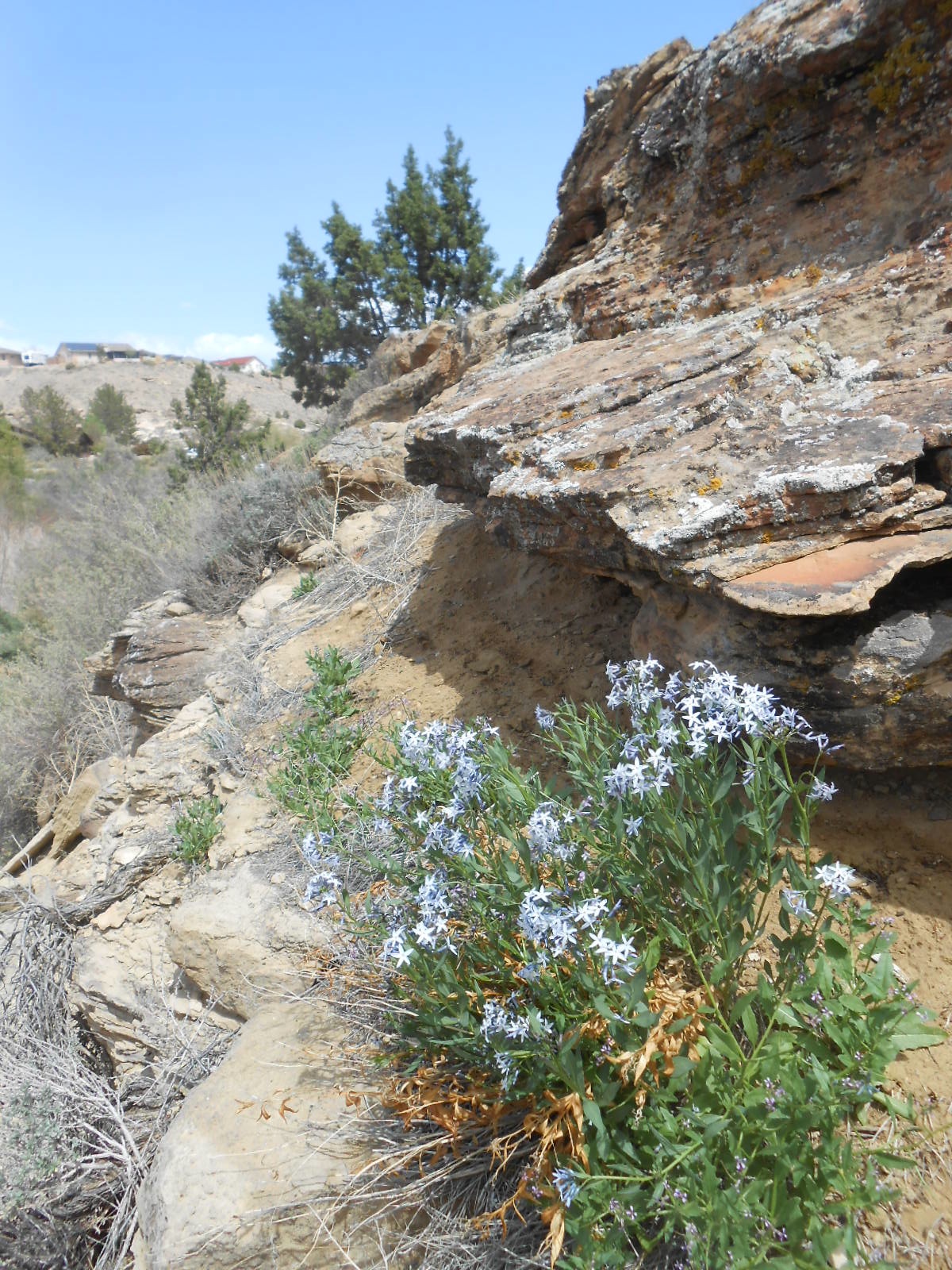
The Jone's or Desert Bluestar

This beastie is well past bloom now, nearly ripe in seed.  It must be plugged until everyone knows about it:  An incredibly long-lived and sturdy (if slow-moving) desert fella (or gal...) that is not rare as much as quite limited in range in nature, and it is recently more available in nurseries. Go get one.
Well, actualy, it is on some governmental "rare plant" list or another.


Amsonia jonesii
Amsonia jonesii

The above shots are wild plants which may actually be within the city limits of  Grand Junction, CO. 

I recently planted one of these in a landscape in the heat of the high nineties we're having, and totally forgot to put a shade on it.  This new plant gets water once a week or two.  It has not flinched, not wilted the smallest bit.  Grow it if you don't already. 

Saturday, June 15, 2013

Public Service #4: A New Technique for Slaying the Bermudagrass Dragon.


Bermudagrass is a beast.   (Cynodon dactylon and friends) A warm-season (summer) sod-forming grass with incredibly aggressive and tough above- and below-ground rhzomes/stolons.  It's great if you want it, but hellish when you don't.
Removing it by hand form my veg garden has confirmed the lore that plenty of its rhizomes occur well below a foot underground.  It's a beast.


A search of the net and the library for ways to remove Bermudagrass provides a few options.  (1. Spray repeatedly. 2. Dig by hand for ages and ages, removing all living material.  (I've done this)  3. Fry it under plastic tarp for at least a year.  4.  Smother it with tightly pinned layers of weed fabric.

Well, none of these were going to work very well for my garden client, but we almost resigned on one... until a miracle revealed itself:

Whoah.  What?

This particular lawn of Bermudagrass mostly had rhizomes within the top two inches, like a normal sod-grass.  Wierd.  For the records, a few spots were indeed deeper.  But not much. We've already dug most of those out.  So, miracle of miracles, a rented sod cutter, set to two inches, did a bang up job of decapitating this Hydra.  I want to type the word again: Miracle.   What profound Providence.
Now we are moving on with the dryland/native/unwatered garden.


The summation:
Technique #5 for Bermudagrass removal:  Don't assume that your patch of Bermudagrass has its roots wrapped around the subway system in Shanghai: Actually check if the rhizomes are as deep as feared.

I'm humbled, again, to an old adage:    Assume nothing.