Sunday, September 6, 2015

Flowers: Just for Fun

 Coryphantha maiz-tablasensis.
Sometimes it's nice to skip the years of growth from seed and go strait to buying a free-flowering plant from Yucca-do.  Probably not hardy outdoors, even here.

Here's a hardy Coryphantha for you- C. similis.  Maybe better known as Escobaria missouriensis var. navajoensis.  This plant is blooming and attracting green native bees in Kevin's  Boulder, Colorado neighbourhood-median-garden.  If you are like me, and miss the obvious, the petals are metallic and reflective. Note, too, it's blooming in summer, which is nice when the bulk of cacti bloom in mid-late spring.


Eriogonum grande var. rubescens. San Miguel Island Buckwheat. It has been blooming for months and I hope it makes my fellow buckwheat lovers jealous.  It's in part-shade, dry clay, watered lightly once a week or less. It was planted April 2014.


Ring Muhly, Muhlenbergia torreyi,  near Bristol Head, Creede, CO.  This miniature and incredibly long-lived grass must be grown more often.  I have seen a plant the same size as this, in a garden, confirmed to be decades old.  To propagators out there:  I will send you material, and Mike Bone of DBG says its easy from cuttings. He's right.


Opuntia englemanii var. linheimeri, Agave parryi, and Heterotheca jonesii.  The mat aster is there to prevent weeds from growing in the Agave which would be dangerous to pull.

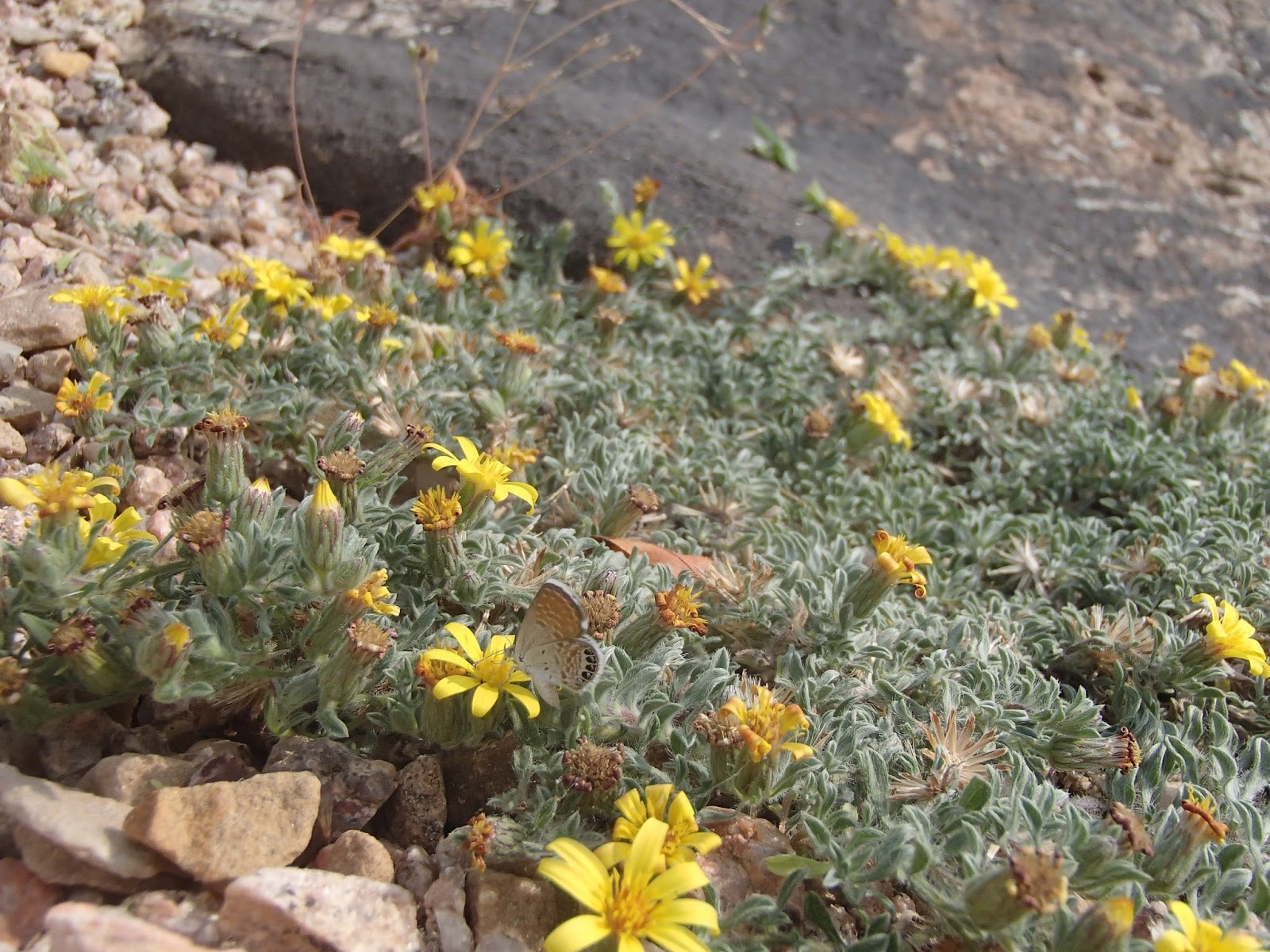
 Jone's Mat Aster or Jone's Goldenaster, Heterotheca jonesii.
She is thriving without irrigation and attracting these fun miniature butterflies.


Bouteloua gracilis, or Blue Grama, brilliantly used in a downtown Grand Junction parkway.  (It's in bloom) I would love to find out how often it is watered and mown.  I am curious what others feel about the aesthetics of an ornaental native grass like this:  Does it look shaggy or like it was a lawn that has not been mown?  What do you think of this landscape?

Wednesday, September 2, 2015

Early Lessons from the KAFM Native Garden.


This will go wrong.

Things will also go right.

Our experimental Xeriscape in Downtown Grand Junction, CO


Let's observe and learn from what fails 
and celebrate and enjoy what succeeds.


What went wrong:

We've barely been "done" for a month, and things are already happening.

Having planted the majority of our plants in the worst possible month of the year, August, we did see some mortalities.  After some autopsies, I can report the three main (avoidable) reasons we killed about a dozen plants (out of hundreds; I'm not unsettled by that).

For the plant-specific addicts out there, Erigeron elegantulus and Eriogonum ovalifolium did not like summer planting. On other words, all of them died.  I'll try them again in fall, which has worked beautifully in the past.

1-The nearby soil was too dry upon planting.  Yes, we watered in the new plants, but a teacup puddle of water in a 20-square foot area of brand-new dust-dry soil will not go very far to keeping a young new plant alive.  We had been dragging hoses around through most construction steps, but some corners of the property never had the whole general area watered.  Next time, we will preemptively soak the whole area, making a great, broad reserve of soil moisture to buffer the drying of young plants. This probably means a sprinkler left for a few hours immediately after the topdressing/mulch, and before we place and plant the flowers.


2-Disturbing too many fine roots on older plants in the heat.  One of our upright 'Taylor' Junipers is awful stressed from this, other things, especially shrubs, died.  (Salvia dorii, Sapindus saponaria)  What happened is that in our fervour to really "bare" the roots of woody plants who have lots of fine roots, we took off too many of those fine roots.   We usually get away with that in spring and fall, but in August, where even healthy, undisturbed plants in the landscape struggle to keep water in their leaves with water shipped from the roots, we really doomed our heavily-rooted woodies.  The fine roots are the source of water and nutrients which feeds the plant.  They are quickly replaceable, but shutting them all down leaves a plant with no life support.  Also, plants which are good-sized who have passed their "teenage" vigour stage also find it harder to push through such a shock in the summer.    Next time: Our very pot-bound plants will have only half their soil removed (not all) and their roots frayed- this is sufficient to achieve what is gained through basic bare-root planting.

3-Stressed out or root-damaged plants.  These poor fools were doomed before we planted them.  It's a trick to keep containerised plants watered in the summer heat, it's even harder to not overwater some drowning-prone natives.  I am not some sort of watering samurai and am therefore not immune to letting plants get too dry and too wet in their pots where I hold them in my mini-nursery.  Generally, given time, the average plant can recover from root damage and be suitable for planting. It can take weeks, months, or even a year for recovery.    Unfortunately, if either of those happen, (over-dry, over-wet) and a plant's roots are damaged, it leaves the plant in terrible shape to get established in new digs.  There is a simple way to avoid this.  This also applies to when you are out at the nursery shopping for new plants.  Next time:  Don't plant plants if the majority of their roots are not bright and white and active.  It is totally worth holding onto a plant for a few weeks until it shows fresh, new replacement roots.    To damage roots by improper watering is a sin which takes just one bad day to commit and so much longer to atone for.


* * * * *


What went right:


A big-top shade-cloth.
Instead of hundreds of tediously pinned-down shade-cloths tents for our new transplants, we used large sheets of shade cloth to cover whole areas of dense planting.  We don't bother to cover cacti; they don't mind.

Passersby.
Several folks stopped by to look at comment on the landscape.  One fellow, who works nearby asked if I dreamed up the idea, because it looked exactly like a place he knew: Twenty-nine Palms in Joshuatree, California.  Indeed, there is a striking resemblance.

Volunteers at our fair community radio station next door came through to see what we were doing.  Many folks saw their first crevice garden.  May the gospel spread, I say.


Tree wraps.
We wrapped shade-cloth around our Junipers. They looked like bizarre art-installation burritos, but this allowed us to bare-root those suckers to prep them for a life without irrigation. That is, after they endured an untimely 97F-degree wind the day after planting.  They look just, if a little matted like a hat-hair-day.

Pulling leaves.
On the leafy plants, we tool 1/3 to 1/2 of leaves off of the plants, just pinching them off, when we planted them. What?  Weird, eh?
Referring back to the death explanation above, see that what this does is reduces the amount of water a plant can possibly lose in the hot air.  Amazingly, by taking a third of the leaves off of our overgrown Gambel oak army, we bare-rooted all twenty-something of them and lost only one.  A month later, they are already putting out new leaves and shoots.  Bare-root planting is awesome, amen.


Rain was trapped.
Using "Rain-harvesting" techniques, the rain which has fallen on the dirt parking lots has been adequately absorbed into a strip along 13th street which will hopefully supply shade-trees with enough water to cool parked cars and the sidewalk.  What I was unsure of, nervous about, and caused me to jump in my truck at midnight in the pouring rain was:  Will that engineered berm absorb the great deal of water accumulated from so much space?  Answer:   My goodness, it did.  Sometimes things you read in books are indeed true.


Also, the as-yet-unromantic but future Gambel-Oak grove garden has remained totally moist the whole time without even the need for introductory watering, because the soil diverts (away from the foundations) and stores the water (under four inches of woodchip)  which runs off the roofs of both buildings.  This woke up bindweed which had been dormant. But we are not afraid; we are persistent.


The right plants.
In other gardens, plants which we are trying at KAFM are proving themselves worthy elsewhere.  Take, for instance, The Jone's Mat Daisy or Jone's Goldenaster, Heterotheca jonesii, growing at 946 S. 7th Street at our landscape at Woodstove Warehouse.  This plant, as flat as thyme (1" tall, and 10" wide) is not just growing, but blooming continuously and attracting tiny native butterflies without irrigation.   I wish we had even more for this new rockery.

Also, Alkali Dropseed Grass (Sporobolus airoides) is used en masse here.  It proves itself to tolerate wet sites, completely dry sites, and still looks like a beautiful puff of smoke either way.  Our friend Allen at Valley Grown Nursery specially-grew us plugs of this fine species; they have been the fastest plants on the property to get established.  Being a grass and being highly competitive (as observed by Lauren Springer) they kick weeds in the butt.

(Sporobolus airoides in a Grand Junction Xeriscape)


Stay tuned for more hits and misses on the Western Slope.


Sunday, August 2, 2015

The KAFM 88.1 Swiss-Army-Knife Garden


1304 Ute Avenue, Grand Junction, CO


We are mostly done with our current project.  We're installing it at a rental property adjacent to and belonging to Grand Junction's Community radio station, KAFM 88.1.  My friend Georgia ("Gardens by Genie") had the idea to connect the radio station {bemoaning endless war against the weeds on the property} and me {bemoaning that there was not a public crevice nor unirrigated garden in my hometown  of Grand Junction, CO.  The answer was obvious.  That my Paintbrush Gardens donated a multi-faceted showpiece garden.  It's a mix of education, experimentation, and shameless grassroots advertising.

The facets:
-Unirrigated landscape supporting shade trees for the home and a parking lot (used for concerts).
-about 95% native plants (CO and other surrounding states)
-about 5% foreign plants, some rare, yet deserving protection/experimentation.
-A mini veg garden
-Swaths of native meadow grass
-Gravel/Desert style xeriscape
-Rare and special treesflowers, and shrubs
-Unirrigated Crevice Garden- this is about 24 tons of sandstone from nearby DeBeque Canyon.
-Unirrigated scrub-oak grove meant to attract wildlife, supported by roof runoff
-Beneficial insect nesting areas; built-in bee houses and dry soil for native bees.


"Before," as they say.

My concept/proposal sketch. 
We had to start with a sidewalk to even get to the front door...

I figured that for future renters (it is currently empty) or the present volunteers/employees of the radio station, some fresh veg would be welcome, so a small 10x10' veg patch was the first thing to go in this spring and add to the palette of features in this garden.  It will be the only irrigated bit. One hundred square feet and one-hundred percent delicious.

Was she called "Sooty" or "Smokey" who contributed the fertiliser to the veg early this spring?  Whatever her name, we are currently eating carrots while we work.  I guess I owe her a carrot, too.

The radio station itself already has a lovely bit of landscaping- night lighting and all- originally designed by Bill Richardson of Dragonfly Gardens some years ago, and currently lovingly maintained by a station volunteer. 


 But ours is different.  It will have a native oak grove.  (Quercus gambelli) My pie-in-the-sky aim is to attract a towhee.    Ya gotta have goals.

The other thing the oak grove does is draw water away from the foundations and use it up to add a bit of shade to the buildings.


Cupressus bakeri ssp. mathewsii is rare in its native California, and threatens to not only survive here but get to be one heck of a xeric Christmas tree. Anything to replace all the dang thirsty Blue Spruce which are planted around town...

There was a perfectly good tree on the premises.  A Siberian Elm once dominated the corner. Let's say we decided it was ultimately in a poor place, would ruin the future landscape, and was being replaced by other trees which will take its role.  It was "transplanted," let's say. It was just easier to do that after it went through a chipper shredder. Now it's job is to keep oak roots happy until they form their own leaf litter mulch.

Ryan, my art school buddy, had the gumption (a-thousand-mile-walk-is-made-of-single -steps sort of thing) to dig out the trunk by hand.  Here he is in characteristic "I've just dug out a giant tree stump, what did you do today?" pose. Thanks Ryan.  With all those stones to set, I couldn't bear to look at a massive tree trunk.


On-site recycling.  
It's sad to take out something alive in such a barren place, but the ex-arborvitae became mulch for the green mormon tea which replaces it { and does not block the window nor pose a fire hazard}.  Elsewhere, twigs and stems are left for beneficial insects to nest in.


Townsendia incana
Perhaps the finest omen was that there is a native wildflower which had managed to establish itself before we started work on the place.  How an easter daisy, normally growing in the Monument gets to be on the dusty rough side of town, one can only guess.  Hopefully we can coax progeny to colonize the crevice garden.

Hundreds of plants are still in line to populate the place.


Stay tuned or stop by to watch the KAFM rain-powered garden get started.

Friday, June 19, 2015

Mecca: Wisley

Wisley's Crevice Garden is Big.   
(click to see its full breadth)

42 tons. 
(The answer to life, the universe...)

(photo of me, for proportion, courtesy of Paul Cumbleton)


In January, I visited one of the largest crevice gardens in the world, one of the most important, and famous.

The RHS (Royal Horticultural Society) Wisley is not far outside of London, pretty close to Heathrow International Airport.

The crevice garden, built by RHS staff (headed by the kind Paul Cumbleton at the time) and led by ZdenÄ›k Zvolánekwas executed in 2010.  It is based on sand, which is entirely invisible.
For nitty-gritty details, see the diary of its construction.

Pictures I had seen of the garden didn't move me much, but perhaps that is the artist blood in me, because visiting it was different.  To be in the same space as this installation is truly, unequivocally impossible to convey in a picture.   Standing next to it was dizzying.  Know that pictures will never serve, that this is a fine art peice that one must be near to experience.  Would you judge Old Faithful by it's mugshot?

The sense of space is staggering.  It is very much a small mountain-range enclosed by hedges and within the auspices of an alpine house.  It's a pet mountain range, if you will.  The dramatic verticality of the stone is so catching, no passerby, no matter how disconnected from nature nor the physical world, could walk by without being taken aback.


The rest of Wisley is a special treat; a jewel in the crown, not to be ignored. Even in January.

The Alpine houses are institutions to themselves, requiring the toil of a fine staff to maintain a stock of plants outside of the exhibit which outweighs what is publicly seen at any given time.  It is so important to honour the appreciation of the relationship between gardeners (or caretakers, curators.) and the exhibit (plants, collections).  This is not immediately obvious to non-gardeners, but plant lovers are the heart and soul of such places.  They know the balance between nerdy botanical curiosity and general appeal, because the not only deal with the public who patently remind them of this truth every day, but live with this balance in themselves.  The truth is that both are critical.  Both are essential.  A stunning masse of fiery orange annuals  may be a hook which lures a human to a deeper love-affair with plants, but there must also be a substance and a culture of sophistication for the world of horticulture in an exhibit somewhere else.  Wisley's Alpine Department is one of those places, and their front-line exhibit is still stunning even if it is not a sugary bed of bright daisies.

There is a trend wold-wide in botanical gardens for sex-appeal, shock-and-awe, and bottom-line-worshipping marketing-efficacy fever.  As a business owner, I am deeply and profoundly aware of the importance of the bottom line (since it is directly tied to being able to eat or not!), however, the culture of "public impression," "public face," "public perception," and image,  driven by a campagn to make better numbers (visitors, income, etc) is starting to dominate like white blood cells attacking their own body.

The quality, the work, the legacy, of botanical institutions everywhere, is suffering.
All this marketing, business-headed priorities, perhaps fueled by the birth of the information age, is a fertile environment for performance-based and purpose-forgetting corporate style.  Worst yet, it sustains itself and progresses forward, since it feasts on numbers and is mathematically justifiable.  But that does not make it right.  

Botanical sophistication is being censored.
Perhaps Mark Twain's quote on censorship will serve:
"Censorship is telling a man he can't have a steak just because a baby can't chew it.'

Shall Botanic Gardens stop planting Lewisia because most visitors don't know what one is?
Many are.


(Photo courtesy of Paul)

Britain's botanical institutions have a longer and deeper history of honouring "collections" (or, the variety and documentation of all the plants they grow and show) than other gardens around the world, whose main goal is an attractive public space which uses plants as the material to get it done.  This balance must be reckoned.

 My greatest thanks to Mr. Paul Cumbleton, who is the retired ex Alpine Head at Wisley.  He took the time out of his day to shoehorn me into the garden in my limited time in London.   I regret having so little time to spend with this humble yet deeply effective man.


An institution which prioritises education and "collections" has plant signs...

A study of the plants in it betray that all sorts of fine things are happier there which were not possible in other areas, and that a small set of plants are not happy, including a fir or two, as I recall, perhaps because they want rich, humusy soils and cannot get their nutrients from the minerals in sand.  But look at the rest that do! 

And even the Royal  Wisley had not even been able to fill every crack, every nook and cranny!

Saturday, June 6, 2015

APEX: the last days


My calculations showed we'd need about 1000 plants for them to even be visible in the garden. It's a big space, so I budgeted for that. Donated plants brought the total aim to 1200 plants.  Soon, I'll have a final count.

The big news was the help.  Just about the time I should have been panicking about being able to get all those plants in the ground, friends came out of the woodwork (and even faraway places) to plant.  Having been quite occupied with the logistics of acquiring such a large number of exotic plants from all over the place, they totally saved the day. Truly, it would have been a disaster without their deus-ex-machina efforts.


Photo courtesy of Van Milton

Margie Frey, left, former horticulturist/head gardener of the Western Colorado Botanic (where she did a heck of a job making more improvements with plants than anyone had in recent memory, in my opinion) came to plant.


Creating the system for recording where everything was planted was Kevin Pykkonen, of Boulder, who has been present and involved with every part of this thing.  His keen passion for the fanciest plants made him a specialist at figuring a few things out.

Gordon and Stephanie surprised me by coming all the way from Colorado Springs. They bravely faced the most barrel-cactus intensive bed.  Gordon did it with sandals.


Van will now demonstrate the right way to plant a cactus.  With salad tongs. A trick courtesy of the Chinle Cactus Club in Grand Junction, Colorado.
He'll even translate into Japanese.

The right depth can be maintained with the tongs while one backfills the hole with the other hand Yep, we even bare-rooted the cacti.  

Proof I actually did some planting myself,
photo by Van Milton


Marla of Roots Medicine Gardens, threatening to show us what a little agave medicine is like.
Marla is responsible for compiling the database of plants which will one day be online for public access.

I really do like the way radially-arranged Agaves look in the matrix of a crevice.


Stomatium sp, from the soon-to-be-closed Timberline Gardens opens in the late afternoon, just as the nearby 'Gold Nugget Delosperma basuticum is closing.  It's a fun handoff.  There are varied opinions, including fruit, as to what the Stomatium ("Hardy Tiger Jaws") flowers smell like.

Deb came down from Boulder several times to get sandy hands. She's been madly engaged with this whole crevice garden style thing.  I'm jealous because I think she was having more fun that I.

Ken was a stalwart presence for the planting.  He made lots of friends by bringing snacks.