Sunday, January 17, 2021

A Flame in the Tinderbox: Crevice Gardens in California (and Earth, Generally)

Photo: Michael Uhler

Forced by writing a book on crevice gardens, I started to think about crevice gardens in all climates, which highlighted where they are (or would be-) most useful. The things that make them powerful- biodiversity, recycling, and microclimate creation- have different weights in different places.

Most of this thinking was informed by watching them take off here in Colorado. So, to myself, I predicted the next hot spots: California, because of its longer history of water-use awareness, native gardening, and a big population of gardeners and plant collectors. Then Arizona- one of the recent fastest growing suburban places in the west, but very limited in water. They have an established “desert” aesthetic that liberally embraces new hardscape styles. I think aesthetics may be a big driver there. Then perhaps Texas, with its amazing natural biodiversity and its own gardening identity. 


What I am more blind to, like a typical american, is the rest of the world. The Japanese have a perfect score of adopting something and elevating it into and art and science, while putting their own stamp on it: Aquariums, cars, whatever. A genus of plants is a genus of plants- like Morning glories or Chrystanthemum, until it goes to Japan. It comes back an entirely different thing. They just have a culture of honing, dedicating, and perfecting skill. Can you imagine what they will do with crevice gardens? They’ll leave us looking like cavemen. Get ready to be an old hat.


I think that crevice gardens (can I just call them CGs now?) will continue to fill in within the intermountain West, Midwest and eastern US, where they are already scattered. Same for the UK, Canada, Ireland, Scotland and New Zealand, places all within the well-connected english-speaking rock garden world. I don’t know much about CGs in Australia yet. CGs have been around western places a while and will steadily grow. Same for Europe. But South America, Africa, middle Eurasia, and all the islands- I have only the vaguest of guesses. I think we’ll see isolated and adapted use of CGs in tropical places, since chasmophyte plant forms can shift seamlessly into epiphytes there. The middle east could be incredible- it’s already a strong influencer connected climactically to Arizona and Mexico.


I don’t know enough about China to know when and how things will develop there. The most populous country on earth, I’m sure it will be big. The second biggest? I’m afraid to betray my own biases, but I don’t expect anything big and soon in India. I have no doubt private gardeners or isolated innovators and geniuses will create amazing things, but the country as a whole suffers from a lot of status quo and a glut of sinecures (easy prestigious jobs with high pay and little work or skill). All the public gardens I personally saw there unfortunately suffered from that weight. The hashtag #rockgarden in India is saturated with narcissistic teen selfies at Chandigarh.


I also guessed that Turkey was deeply unlikely to see crevice gardens anytime soon- and boy was I wrong. I lived one summer in Turkey, so the place is a certain home to me. The first public CG is at the Nezahat Gökyiğit Botanical Garden in İstanbul. It’s big, and they feature turkish endemics in a sophisticated way. Then, in SE Turkey: Antalya’s Mediterranean University reached out to Paul and I to build one in marble, no less, but the plan was snuffed by the pandemic. 


The Crevice Garden in İstanbul's NGBB.

Photo courtesy of Mike Smedley, future host and de-facto ringleader of June’s NARGS annual conference. 


But I’d like to swing all the way back to my first prediction: California. I was keeping my ear to the ground when Panayoti was the first to let me know it was happening. 


The Tilden Regional Park, on the foothill-ed edge of Berkley, CA, specializes on California natives, honoring the most floristically diverse state in the union. I was generously filled-in by gardener/builder Michael Uhler and director Bart O’Brien there about their project. In the last two years, they’ve set tons of a glorious rock they call “Mariposa Slate.” They have taken a slow, focused and deliberate approach to maximize and leverage the best of what a CG can do to grow specific plants. Let’s be frank- most of us build something cool and see what we can grow in it. They have taken a more thoughtful path with a focus on Sierra Nevadan alpines. Here is a link to a preliminary newsletter article on it.  


The next issue, Vol 25:1 (2021) will feature a meaty and wonderful article by Michael about the whole history of the crevice garden and a deep look at the plants it was designed to host and their origins.


Photo courtesy of Michael Uhler


Bart says that there are now at least three private crevice gardens that were influenced, spurred, or otherwise affiliated with Tilden Park project. I am reminded of the time when Denver Botanic’s Mike Kintgen put in the first two at Denver botanic. That was the spark that ignited interest in Colorado and well beyond. 


I am holding onto my seat and grabbing for the seatbelt to see what is about to happen in California. 


Friday, January 15, 2021

Is this the first? Crevice Garden conference/study day

This may be the first all-crevice rock garden event I am aware of. NARGS is hosting an all-day zoom conference: Saturday Feb 6th.  11am-5:30pm EST (you can watch it later if you are in a different time zone, luckily!

The CREVICE GARDEN VIRTUAL STUDY DAY

$25 for members, $50 for non-. My talk is mere business and pales in comparison to the diverse fun coming from the other five presenters, including the anticipated lecture debut of Susan Sims. Also, Talks will be nice and bite-sized. 

The nice thing about online events is that you can pick your own booze or snacks, and whether you wear pants or not. I enjoyed a green cocktail (gin and chartreuse) to honor a cactus club meeting last night. 

What will you bring to the event? 

(click above if you have not decided)


Friday, January 1, 2021

The Psychological War in the Garden

I feel like all of my gardens are a war. A war between two concepts: peace and excitement.

Peace is: meadows, grasses, harmony, unity, relaxation, comfort, the steppe, grain fields, being able to see far. Safety, order.


But excitement- it’s variety, color, surprise, being busy, nooks and crannies, jarring contrast, a messy plant zoo unified by nothing but lust. 


I think this battle has not always gone well: it’s worst collateral damage being the failure of the general design of a garden I’ve made, where the plant collectorship gets out of hand and the space has no spirit of its own. Or, if the other side decisively wins- something that is pretty, giving you an immediate inviting feeling, but basically boring beyond that, functioning like an agreeable background to whatever non-botanical activity you are doing like an overly quiet and polite host with no opinion of its own. 


It’s taken me years of making gardens that some folks enjoy but leave me cold to realize this. Finally knowing the exact problem has made creating solutions fairly easy. 


I don’t think that it’s about a “balance” between peace and excitement, but perhaps layering them. Or fostering their coexistence. Like oil and water- a hackneyed metaphor we take for granted: “yes, yes, oil and water don’t mix, shouldn’t be mixed” we say, but I ask- what is butter!? Glorious! Certainly you wouldn't defame butter? A natural phenomenon, a mixture of oil and water, thanks to emulsion, a brilliant mechanism that brings the two together. What is the mechanism to marry two disparate impulses?


Here’s one for gardens. Just my basic go-to at the present. Lay on the harmony/unity heavy enough (to make peace/space) that you can lace it pretty liberally with variety. In a meadow, this can mean a matrix (which doesn’t mean a network, it means a womb) of one or two types of grass, interspersed with a variety of bulbs and herbs. In a rock garden, harmony can be solidly established by a heavily used single kind of rock, and plants can basically be anything you want, but the accident that they are all smaller or cushion-shaped will, as a byproduct, create a certain unification among all the different little guys. 


For a lawn, that means a totally predictable, 100% safe monoculture of turf with no room for any variety or anything dangerous like excitement, and that is dead boring and you know it. 


Another example of meshing variety/fun and unity/order:

In pure numbers, this can mean a garden rugged-out with three dozen Mexican Feathergrasses, peppered by half a dozen accenting bunchgrasses like Muhlenbergia or something, an ephemeral underplanting of two hundred muscari, all of those creating a super solid foundation, a vibe, and then finally, start getting interesting or varied with a dozen Echinacea, ten Eryngium, twenty Kniphofia. Lastly, the variety can be represented and solidified with say fifty different species in quantities like onesies and foursies, who are embedded in the grasses like gems on a crown. If there is only one emerald among the mixed gemstones on that otherwise golden crown, will it look like it belongs. And these plants for variety get even better if they are seasonal- appearing at certain times, creating surprise, keeping you interested. The fun part here is that if you take out flowers over the years or try a new one the rest of the garden won’t notice. It won’t disrupt the vibe. The party will go on while dancers come and go.


In understory or forest-like plantings in shade, it’s too easy to make harmony, because in nature, the understory is often dominated by sheets of one shade-tolerate ground-cover for acres and acres. What is tricky is variety, which might just come down to the long game of hunting down a variety of plants that will put up with shade and provide temporal, color, or textural variety. Shade gardens are the hardest for me because I’m a plant nut, a life devotee of that botanical variety, and as a result I think over the years I’ve become careful of where and how many trees to plant. 


Back to rock gardens, because we like those. They’ve always struggled to have unity. Their potentially jarring disarray of plants lovingly kidnapped from every godforsaken rocky spot on earth have repelled the more sensitive gardeners of fragile design tastes for years. How do we deal with that? Why don’t natural rock gardens feel as jumbled? I already mentioned that an abundance of stone is a solid, foolproof way to nail down unity in a rock garden so you can garden with shameless taxonomic plant-lust for ever after and get away with it artistically. 


But what if you don’t have a large area or the luxury of truckloads of rock? You have a few other choices. The unity doesn’t have to be the species of plants- it can simply be their form or color. For instance, you could unify a rockless garden of rock garden plants by repeating the bun-form: seventy different species, never two of any type, say, of Acantholimon, mesemb, cactus, Dianthus, Campanula, Eriogonum, Draba, Arenaria- but all with that same half-dome form. They will have an undeniable harmony and familiar resemblance, lend the garden a very solid, specific feeling, while providing a total buffet of botanical eye-feast and brain-treat.


Crevice Garden at Denver Botanic Gardens


I think I’ve barely begun to let myself think of ways to extract variety and calm, the purveyors of excitement and peace in a garden, and make them happy bedfellows. Wouldn’t it be wonderful to be able to garden with not only plants of the rarer beauty in nature, but to create spaces that evoke natural landscapes of rare beauty?

Wednesday, November 4, 2020

Introducing my Newest Mistress: the Dry Seed Meadow


(Penstemon eatonii, Hesperostipa comata, and the wrong kind of thistles.)

Now, why get sucked into meadows?

Wild grassy expanses have long sung a siren’s song to me, perhaps for reasons brought up in the Steppe book having to do with humanity’s pre- and post- agriculture relationship with the steppe biome. It has called to me like a silent, logical truth, too, for years when I have experimented with irrigation-free native plantings: I found that so many patches of earth seem unstable, drawn away from what I tried to plant, until they are clothed in the resplendent robes of grasses and forbs. I’d plant yuccas and xeric ground-covers, but thick galleta grass would take over, rich as a wheat field. Weeds in the gravel would tell me that “there is room here yet- these plants are not enough.”


I spent a few winters on research-benders to find out a few amazing things. One, that there is such a thing as a desert grassland, one book having the most enlightening pages about them, and two, that my hometown, with its break in oral history between the original locals and the new ones that suddenly replaced them, is nestled in a dusty valley that was early desertified, almost certainly by overgrazing. 


Why would tall grasses want to dominate front yards in my desert hometown? Turns out that the desert grassland ecology teeters on the edge of being possible- Ours was established by a bygone climate and is largely not able to be restored because the climate is too dry now, and has become even dryer in the last lifetime. But in a front yard, we can totally bring it back because it sits on a forgotten foundation of nutritious soil from years of lawn, agriculture, or irrigation.  


I realized that if I wanted to plant something that would last the longest, be the most resilient and permanent, it had to honor the soil and climate that was there. And honor it closely, or it would always try to change on its own.


Now, they’ve been doing meadows in Europe for a long time. Having trashed most of their pristine nature literally thousands of years ago, and the machissimo high of domination having worn off,  they crave to bring nature back into their cities.  Americans are getting on board, too- John Greenlee wrote one of the most influential books I’ve read on it. 


Very recently, James Hitchmough has been testing not only starting entire large, expansive, perennial gardens from seed, but also public/human response to them. Now that’s a scientific way to ensure people like your gardens! He’s truly bridging the most-feasible with the most-ecological. He’s got a special planting system that is working super well in the UK, and a few other places.  


Now, I, like most Colorado gardeners, are weary of any foreign planting advice because it usually doesn’t work. But I had accidentally discovered in some of my own plant projects that there is the possibility of a Coloradoan twist to this seeded meadow thing:


As an accident of a project in 2017, I used a few dumptrucks worth of clean, screened dirt to overdress the whole area before I seeded it with dog-friendly dry natives.  Turned out that was what Hitchmough would call a “sowing mulch” and it really works.

And then it all sunk back, with less attention, to the murky depths of my mind.


Until we bought our place, and just goofing around, I threw out several bags of old seed from old reveg projects. 


(April 2019)

(August 2019)
And without water for two years, it did this: 
(Baileya multiradiata, Mirabilis albida, Gaillardia aristata, Sporobolus airoides, Cucurbita foetidissima)


(Late May 2020)

(September 2020, no rain since April.)

Then I noticed.


You may say “There is a hitch. There is a trick, there must be a catch- because Fruita, Colorado only gets nine inches (230mm) of natural annual precipitation.” And you may be right- I’ve stared down into the bottoms of deep holes dug for nearby power lines, lamp-posts, and basements to see standing water about 6-8 feet (2-3m) down. Healthy trees growing without irrigation on occasional vacant lots are also testament to groundwater. So yes, I think there is some available to even surface plants.  Still, I am impressed when they bloomed right through a record hot summer. And I must know where the limits are. 


Can it be made to work, reliably?

Instead of this idea remaining a back-burnered fascination I’d dabble in from time to time, it lurched forward full-throttle. Several friends and clients, having seen our front  yard, asked me to try the same at their places this fall, and then I was overjoyed to find that the CSU Hort agent for Douglas County, John Murgel, is creating trial plots to investigate the feasibility of adapting the Hitchmough planting system to Colorado, to be left unirrigated, to boot. John reached out to me because he found I was the only one around crazy enough to be sinking so much time into testing this stuff out. So we’re comparing notes and he’s patiently teaching me spreadsheets as we bravely march into uncharted meadows. 


But at this point, we are three: our friend Kevin Williams, Horticulture Specialist, at Denver Botanic Gardens was probably the first forerunner in Colorado to precisely execute this sowing system three years ago along Josephine St, exposing the most critical adaptations that will be essential to make seeded meadows a thing in Colorado. 


There is one huge crossover with crevice gardens.  Planting media. I’ve been on the intensive search for years to find the perfect “goldilocks” mixture or perfect soil-replacement media to be the compost-free “dirt” to use within crevice gardens. It’s been a long trip. And I won’t wade into the details, yet. And I won’t tell you what I’ve found so far. But it seems like the perfect crevice garden media may also be the perfect "sowing mulch" for dry seed meadows.

Now, I’m not withholding latest discoveries in the best way to do these things- I’m choosing to not give unripened advice yet because these adapted techniques are still new and I’ll remain dubious of them until they truly prove themselves. But don’t worry, we’re working on it.  


Why is this so damn exciting?

Let’s face it, people don’t do stuff until it’s the easiest thing to do. Many studies and research projects

 have shown that meadows beat lawns hands down, but successfully pressuring landowners and contractors to bother themselves to learn a new skill to build and maintain a meadow is only possible when the savings are staggering enough. You know it. Humans can be real sticks in the mud and cling to regression like a wart to a lip. 


It is so early in the test phases that at least locally, I can only report my own back-of-napkin math:

An experimental plot I just did for a friend was $2.51/square foot. The average fancy xeriscape I did as a landscaper years ago ran about $4.50/square foot.  And I hardly made a living back then…


The Xerces Society reports that out East, a seeded meadow is 2/3 the cost to install, and less than a seventh of the maintenance cost, compared to turf: Meadows versus Lawns 


If we can find a way to pull this off, this could save open-minded homeowners- not to mention city municipalities and corporate landscaping- tons of money.  As a byproduct, which is of course what drives us biophiliacs: it’ll increase biodiversity, feed insects (and as a result, birds and other wildlife), reduce fossil fuels, and increase general goddamn beauty in these parts. 


This could mean that there is an immediate monetary incentive to rip out large expanses of turf, especially in HOAs, road verges and municipal medians, and replace them with flower-filled crowd-pleasing bug buffets. There are real reasons that this hasn’t been done already, and this new planting system will weaken those reasons. Now that’s why I’m more than a little excited for it. 


I think it’s what the dirt wants. 


Thursday, September 3, 2020

The Art of an Annex: Crevice Innovation in New Zealand

 I told you so. 

That the New Zealand rock gardeners would take crevice gardens into their own hands and innovate right away. While I was there, we did make plans for an extension of the crevice garden to span across the main path from its main seat in the heather garden to include a corner of the main rock garden which needed renovating anyhow, so we rationed some stone for that future project.

My friend Hamish sent me these pictures of what they recently did, and I'd like to point out some specifics of good art in its design, and some opinions of mine. All photos are his. There is a thorough write-up that recently came out in the printed NZAGS bulletin on the project. 

They've also put out a really great "How to make a small crevice garden" brochure, something the world really needed (and why I hadn't done it already? I'm an idiot.) 

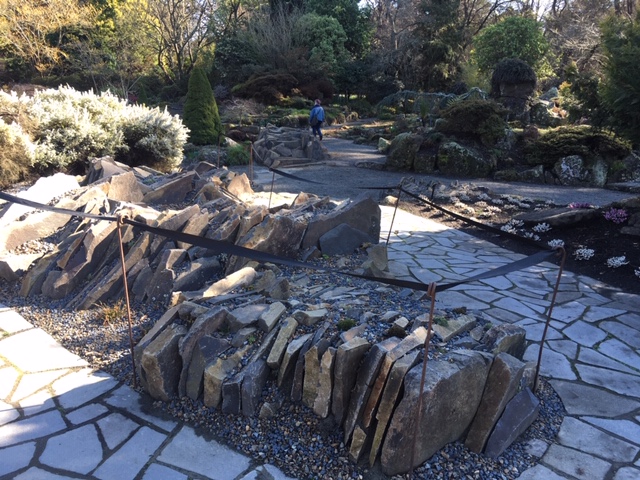
So, this is the main Crevice Garden at the Christchurch botanic- the new annex is visible in the background next to the blue figure. (Looks like they've got some temporary ropes to keep folks off the bed- I've seen this so often that a new crevice garden is climbing-candy until plants have well grown and make it obvious that it's not a toy!)

New annex in foreground, main installation in back.


What I wanted to discuss was this.  Notice how it is :

1. Oriented with the "strata" of the other garden.
2. the Annex is a massive shape that is about the same size and form as the big historic stones
3. The flat-topped stones in the path follow the logic...


Now the path treatment is what I wanted to get editorial about. I love this. 

There has long been discussion on the ZZ-style of setting stones in the path through a crevice garden, oriented with the strata, but whose tops are flat for good foot use. The idea is that it looks like a human roadcut has been made through solid stone. It also offers great stability, adding a solid "footing" for rocks that make the base of the garden.  It's also super useful as steps within a sloping crevice garden. It was my favorite part of my last Vail project, in fact.

I agree with the concept, but what has bothered me is that it often appears in places that meet otherwise naturalistic, eroded-looking faces that "return" to the ground. And I would argue that in nature, an eroded cliff face like that dives underground and is buried by soil, not by mechanically cut rock surfaces. I've never liked where a nice crevice cliff meets a flat-creviced path. If a cliff did meet a cut path, then by that logic, the vertical cliff, too, would have been clean-cut (and in the few gardens where I've done this, that is how I treated it).  Basically I feel that the path paved with stones is cute, and in-keeping, but not strictly really natural or necessarily artistic. If it were, it would have irregularity or some cue that it, too, is a naturalistic stone, rather than a novel patio paving that sort-of matches the rock garden. It usually looks to me like there were leftover rocks that needed disposal. 

BUT, here is where it works for me.  And very well. Here, the natural cliffs return to the ground and it meets gravel chipped surface,  suggesting the rest of the form is buried underground, but where we see the path-grade flat crevice surface, it look every bit like it was a solid mass- that was cut for the path.  It's even the shape of a big sliver of rock. I love this so much. It's so well done.  What is more (bonus art points as far as I'm concerned) it functions in the design of the garden as an eye-catch for the passerby on that wide main path who is looking at the ground and cruising through the park on their way to work. (Wide/strait paths lend themselves to fast walking)   It catches the ground-level eye and draws a shoe-staring viewer to look at the garden that flanks them welcomely.  I love it. 

We're going to have to get to work, and hard! - the New Zealanders are putting us to shame!

Wednesday, August 26, 2020

The Prickly Thrift seed problem


Acantholimon caesarium, sold by Arrowhead Alpines and growing at APEX.

As a drooling young rock gardener, I was told time and time again by the old timers that Acantholimon seed was always 95% empty, infertile seed, for some mysterious reason. I even saw a botanical illustration once that pointed to the dried out flower and called it the seed. Everyone has a story about it: never growing from seed they got from exchanges, only growing from certain czech seed hunters' seed, et cetera.  And everyone had a different explanation for why they were rare from seed, leaving most to be grown from cuttings. And yet you'd see the odd seed volunteer plant appearing here and there in folks' gardens.

(Soft pink flowers of Acantholimon armenum are gracefully replaced by similar white clayx which are generously full of lies and disappointment. None of these have been fertile, ever.)


Fifteen years later:

I've beat my head into this wall for long enough to share this:

Some plants produce mostly good seed, others none. Most produce little.  I expect it is a pollination thing- is there a bug with the right sized lips or tongue or whatever to do the deed? When I looked into it, I found just one paper in turkish about sweat bees pollinating them, but at APEX, Acantholimon halophilum is covered with mostly honeybees and a few others. Those plants usually produce loads of good seed, last year was an exception. Also, perhaps importantly, it may be necessary for there to be more than one lonesome-george plant so they can pollinate one another. This is conjecture. 

Whatever the case, the good news is this: you can check and see if seed is viable- with a plump embryo and endosperm. You need a pudgy parachute. Rumour and oral history says a czech seed hunter used the term "pregnant ballerinas" to describe the look of a good seed. It's just visible. But even better, just smush off the papery calyx from the seed and see if it has the goods:

A thing that looks the size, shape, and color of a black rice grain. Now you know.  I wish I'd known years ago.

Acantholimon seed. See two good ones and something that isn't, on the left. On the right, three familiar entire seed contraptions- two look full and promising and the middle/lower one looks empty.  

That's it.

Thanks to Mike Bone at DBG for being the last person I bugged about this and confirming what I thought I'd figured out.

Now you can grow out sweet little pots of seedlings like Bill Adams' in the picture, or avoid empty pots resulting from empty seed.


Seven Recipes for Baking your Ornamental Fescues

 Do you love ornamental fescues? The garden varieties are wonderful little clumps of evergreen softness. They seem like the perfect entourage for any meadow plants, and I’m really into meadows right now. So I need that. Like a sweet tooth.

But I’ve long observed large commercial plantings of Festuca ‘Boulder Blue’ and his brothers just die off after a few years- they just don’t seem to live very long, especially down here in a hot desert valley. It seems they do better in the mountain towns of Colorado, and even Denver and Fort Collins. But I cannot live without some fescue action. Lots of it. So here let me share what I’ve learned about them. For reference, all of these I'm comparing are irrigated once a week in summer, less in spring/fall, no exceptions. Here are the seven taxa I’ve tried in this oven we call the Grand Valley:


Festuca ovina

Festuca arizonica

Festuca saximontana

Festuca amethystina

Festuca glauca 'Beyond Blue'

Festuca mairei

Festica ovina ‘Eiler’s Beauty’


Festuca ovina seems to do well with dryness and part shade. Its seed is cheap. It has a lovely delicate stature just under a foot. I was even a star performer in unwatered landscapes in their first year. But year 2 or 3.... POOF!  Gone. It doesn't replace itself with seedlings reliably enough for that not to be a serious problem. In the mountains it has been a stalwart weed suppressor and living for years and years.


This is Festuca saximontata, seed grown, at its best year two. It's being useful inside the compost bin about now. The thing is, Grand Junction, I believe, crosses a threshold of heat that is just too much for some plants. If it does not outright kill them, it slows them way down, keeps them from ever amounting to much, or slams the gas pedal down on their aging process. 
This species might be the worst one for dying young in this climate.

"Dry" in the mountains means something different than "dry" down here when it is 100F (38C) for weeks, and no rain for months.  And I am certain plants notice. 

It's easy to get Festuca amethystina  mixed up with ovina; but this one has a certain purple cast to the leaves. It's still in its youth, so I'm avoiding a love affair with it until it proves itself. I do like the sparser blooming so that colorful neighboring flowers or its own rich leaves are not hidden.
Say a little prayer for the lifespan of tufted fescue.


But lo! Who is this handsome beast!?


Who is this generous fountain of flower, this urgent urchin, this dense denizen, this total rockstar?   This is a selection of Festuca ovina from Turkey called 'Eiler's Beauty.'  


Just compare 'Eiler's Beauty' (left) to a regular sheep fescue Festuca ovina (right).  So much flower power.
So far, this guy has not died yet.  It's now two years past the cutoff point that throws the others in the bodybag. I really hope it keeps going. If it dies at seven years, I think I'll be OK with that.

Its smallness has made it my first grass to trial as a steppe garden/rock garden transition grass, because it can cast tiny shadows on cushion plants huddled under it without smothering them. I have long wanted to replicate the conditions of a wild steppe with the open spacing between clump grasses, wondering if it created a special environment for some of the more elusive steppe plants, especially rot-prone geophytes. 

Festuca glauca 'Beyond Blue'  is indeed more blue that other blue urchin things widely on the market. I don't know that we really need yet another, bluer blue, brighter light, louder speaker, faster car, bigger house, taller skyscraper, oranger orange, longer johnson or whatever to make life better- the wizards are always at work. Whatever. It does of course compliment orange Kniphofia (probably 'Papaya Creamsicle' or yet another over-the-top ridiculous name for a decent plant as seems tradition.) 

Oooooo, oh lordy. The first season for Festica arizonica, it develops a very fine, very clean limey-green tussock of leaves that makes the common Mexican Feathergrass (Nasella tenuissima)  seem like an unrefined mutt. For a month or more, everyone asked what it was, in a garden of hundreds of plants. Then the flowers come out, looking a little wilder and natural and less formal, sending the plant dancing into the garden's background with arms waving comfortably in light breezes.

But then, year 2 or 3, the ratio of dead to living leaves slides down that slippery slope... But you love it and you remember its glory days, so you keep it 
just in case it's still alive.

I assumed it was fully winter dormant here, but in the third spring when fescues are supposed to turn green, this, the specimen that originally hooked my heart to them, did not wake up.  I tried burning a few to see if that would stimulate something. 
Cute. 
No. Dead is dead.
They've all eventually done this. Damn.


Luckily, there is one more reliable species to discuss in this otherwise mostly disappointing poop show. 

But it's big. 3' (1m) or more wide. Festuca mairei is the Atlas Fescue. Basically a green and improved version of blue oat grass (Helictotrichon sempervirens) It lives forever, it's evergreen, it tolerates dryness, and tolerates shade better than any other grass I've grown in Colorado. It is a graceful thing that my photo doesn't betray, and gets more graceful with age. It is a structural backbone plant that holds the garden together like the bass and cellos in an orchestra, never standing out with the bright melody. Being evergreen, there is no room for weeds or little flowers under it, only things like tall lilies or foxtail lilies. Why it is rare in commerce is beyond me.

Now, I have grow F. idahoensis and a few others like it in the past and I need to try them again and pay attention to their longevity. I'll let you know what happens. 


Until then, seek out the Atlas Fescue if you need a shrub-like grass, and let's cross our fingers that 'Eiler's Beauty'  keeps jammin' on: