Wednesday, February 19, 2014

Pan's Gardens: Boulder Garden-scaper Rockstars


Our dashing GQ cover-boys, looking very sultry.

Meet Ryan Durfee and Paul Montgomery of Pan's Gardens, Boulder, Colorado, USA.
Last October I took an opportunity to work for a week for these fellas to see just how they do business, taking those lessons home to my nacent new business.  Or maybe I worked for them to assimilate thier swagger.  There's a good chance of that.

 
I need some rockin' door stickers like theirs.


Pan's is an organic company.  You've read about solarizing lawns to kill them (as opposed to hosing them with poison), now you can see it in action.  Paul and Ryan offer some incredibly efficient, tidy, and detail-oriented and mainenence service, as well as earth-conciouse installations.  The above has become a "Peasant's Garden," utilising native shrubs, if I'm not mistaken.

Pan's Gardens is bravely going places that so many are only talking about- here is a meadow-style strip recently established.  Look out for Meadows in cutting-edge progressive landscapes in future.  Folks like Ryan and Paul are bearing the weight of inventing the wheel we'll all be riding and taking for granted in future.  Read about thier philosophy and drink in their work: their website is weird inasmuch that it is not painfully commercial, but fun to peruse.


Ryan shows me his recent xeric installation, featuring maximum biodiversity in a small space, which means there are a dozen things in bloom, even among young plants, in October.


 It wasn't all work and drinking espresso- we cruised gardens and looked for green trouble on the streets of fair Boulder.  We even found a greenroof, and upon knocking on the front door of the house on which it grew, we found that I had consulted these folks and sold them the first plants for their roof some years ago. What fun to see how my suggestions did or didn't work.   The owner let us waddle around and have a malenky bit of a look-see.
This is us on the roof: note the refleciton of the second-storey-neighbour!

Private greenroof in Boulder, CO, excecuted by its enterprising owners. (Not to mention a frugging fantastic rock garden!)


I'll take this line to thank Paul and Ryan, as well as Ryan's family, for tolerating and kindly accomodating me.  

They do look after some beautiful places.


Friday, December 20, 2013

The Year of the Lecture

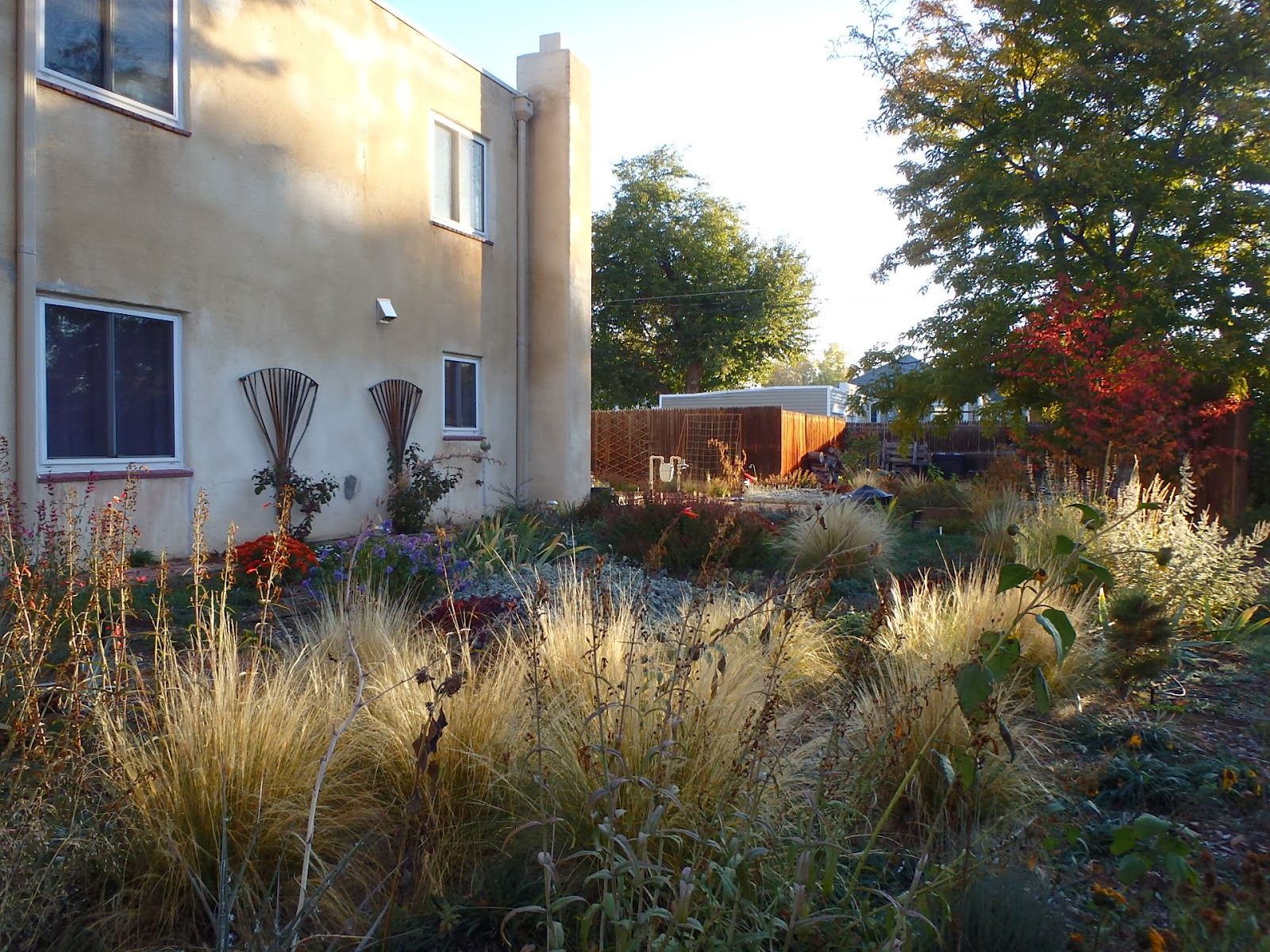
(Nasella tenuissima,  Mexican Feather Grass, frames my friend's garden in Denver, CO)

2014 has become the year of the touring botanical lecture for me; I'm lucky enough to be all over North America giving talks.  A nice way to avoid doing actual work.  

Here's a moment to shamelessly announce them if you happen to be in the area.


18 January  Seed Exchange Logistics: Rocky Mountain Chapter of NARGS (at Denver Botanic)
21 January   Lesser-known Hardy Succulents: Colorado Cactus and Succulent Society  (at Denver Botanic)

15 March: Piedmont Chapter of NARGS, Raleigh, NC: (Plant Hunting in the Caucasus)
22 March: Southern Appalachian Chapter of NARGS, Asheville, NC: (Crevice Gardening)


12 June Calgary Rock & Alpine Garden Society (or, I love this: CRAGS!) Calgary, AB

Unexpected Autumn Colours, 2013 edition. In winter.

Owed to the fervent effort of avoiding winter blues and sitting-down activities, a fall colour blog just before Christmas.

Mirabilis multiflora doesn't always do wild things like this.  These are calyxes. (the leafy wrapper of the flower)

Winterfat, Krascheninnikovia lanata lets its old leaves go pink while recent ones, blue-white, will remain for winter.
Krascheninnikovia/ Eurotia/Ceratoides lanata's ("Winterfat" gets to be an appealing name!) fall color is more apparent with the aid of Catalpa leaves...

Ginkgo biloba and Euonymous elata

Ampelopsis brevipundunculata, or Porcelainberry vine to us mere mortals.

Enjoy your winter. 
Or survive it to enjoy the spring, at least.

Friday, November 22, 2013

Two for the Bugs


"Knowing the insects doubles one's gardening pleasure..."

from my friend John, for whom a love of bugs runs in the family.


A honeybee redeems a Goathead/Puncturevine (Tribulus terrestris) by visiting it.
See, there is a purpose for even the most hated of weeds.
Well, -almost redeems it. We can look at this as lemonade from lemons...


Phiddipus aff. cardinalis.


Aphids on Showy Milkweed (Asclepias speciosus)


I had read the warning in drip-system books about bugs crawling into things and didn't really think much about it. But I was reminded when these four tragic gals turned out to be the clog in the wand-end rose; these crickets entered from the other end of the tube at the spigot (which I'd taken off and drained as a freeze precaution.) Nice. I must remember to clean out all the nursery's tubes before I turn them on next spring! Lesson: find some sort of cap to put on open hose/tubes.


Leafcutter Bee activity on leaves of Amelanchier alnifolia. Rose leaves are among the more common thin-textured leaves which are used. The philosopher in me really enjoys the fact that there is no real solution to this problem (no sprays, OK?) short of covering your entire shrub/tree with a fine veil of some sort pre-emptively in spring. I've never heard of anyone troubling themselves so much- Gardening should be fun.

And it's fun to look at bugs.

Public Service Announcement #6: Ants Attack Agave.

Bad News. 
But rare news its seems, thankfully; no-one seems to have heard of this, which excites the mission of this blog- to document new things in this universally-widening but often redundant internet.

Extra! Extra! Ants Attacking Agave:

This is either Agave parryi or A. p. neomexicana- I forget- but the bases of its leaves are being consumed by "Pavement Ants" (perhaps Tetramorium caespitosum) under a protective shell of glued-together dirt bits, which they will do when they are ranching aphids on the base of a plant, like strawberries.  I have brushed this shell off a bit to reveal their dirty work! 

Dirt-awning intact.  Seeing this on a plant disturbs me. It always means going to war with friends, a war which generally doesn't really end, but ebb and flow.


The story and my working theory are this:  This Agave is not the only plant being eaten; they are otherwise exemplary newly established plants in a prvate home landscape I made this year in Grand Junction.  A Few months after planting, the plants all grew phenomenally after the monsoon rains, and this is when a Globemallow died out. Upon closer inspection, it had been "girdled" by ants, who had built their dirt-shed around the base of the plant and removed the joicy outer lay of the stems of Sphaeralcea grossularifolia (Globe Mallow), Hymenoxys/Tetraneuris/Haplopappus scaposa (Sunshine Daisy/ Perky-Sue),  Desert four-o-clock (Mirabilis multiflora) and Calylophus hartwegii var. fendleri (Fendler's Sundrops.)   They have so far not touched Prairie Zinnia (Zinnia gradifora), Mohave Sage (Salvia dorrii), Claret Cups (Echinocereus triglochidiatus/mojavensis) nor Saltbush (Atriplex confertifolia)

The landscape has been organic (in the popular sense) so far and has "sustainability" written all over its insides, so I tried "natural" methods: garlic and pepper powders.  The ants, I thnk, rubbed their jointed limbs together and said "Oh, we love Itialian!" and chowed down again.  I tried Cayenne pepper. The bits that did not wash away in the rain were ignored by the ants.  Who kept eating.  I was out of town to re-apply, so the client dumped a fat heap of it down into the rosette, and what appears to have actually stopped the ants was that the rain-wet Cayenne pepper became a hard cake physically keeping them from getting down into it again.  Alas.

My theory is this.  It's pretty weak. Once upon an April, this landscape was short-mowed bermudagrass and weeds, (mostly Kochia and Purslane), and the ants were living there sustaining themselves for years on the mini-ecology of weed parts and bugs that eat the weeds.  This summer, some clever dick with a pickaxe came in, removed the bermuda sod, weeds, most organic material (including surface weeds seeds) , added a thin layer of compost, and a thick layer of pea gravel dotted with native plants.  A real moonscape compared to the dusty jungle of weedy turf the ants had built their empire in.
Having had everything taken away, a sizable population of ants underground became more desperate than normal, forcing them to acquire new tastes, or die.  
 The End.


With the ants brushed away, too, the poor plant's fibers are exposed. This was early on and they returned several times to make it much worse.  I hope it survives the winter.

If you, too have ever seen this, please share, as it seems pretty undocumented.


Monday, October 21, 2013

Plant Probation: Euphorbia rigida

 The Mediterranean Spurge


It's rigid, yep.  Like all its relatives, it bleeds a milky sap to which the majority of humans seem allergic.   Just use gloves.  (A brilliant little blog by Denver Botanic's Panayoti Kelaidis on Euphorbs here.)

So NOTHING eats it.  Rabbits, deer, mice, deermice, giraffes...  Nope.

It looks similar, but it is not at all, in fact, the noxious nasty "Myrtle  Spurge" or "Donkey Tail." Every time I see that someone has transplanted the Myrtle-Spurge as an "heirloom"-style way-easy garden plant, I want to tear it out and secretly replace it...

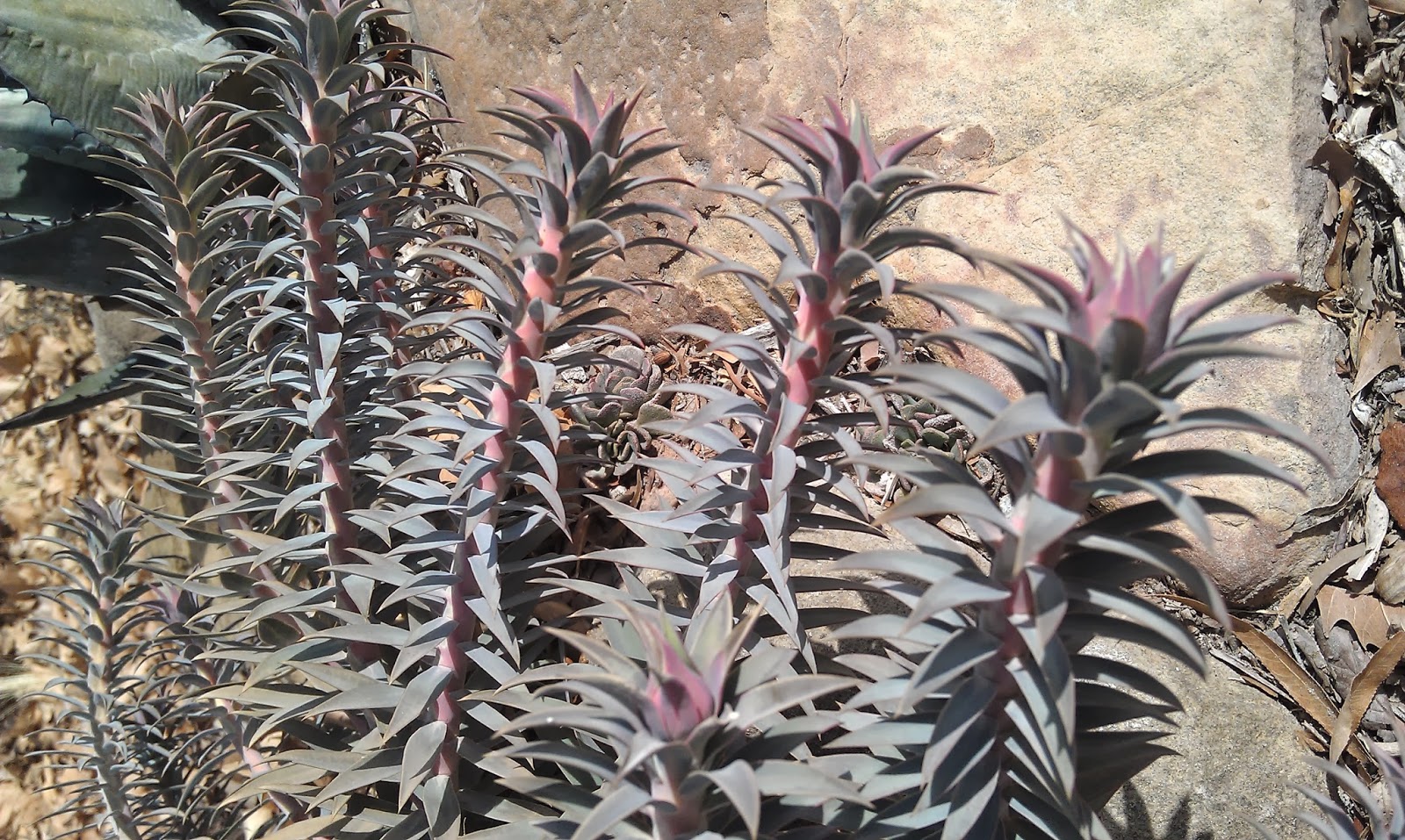
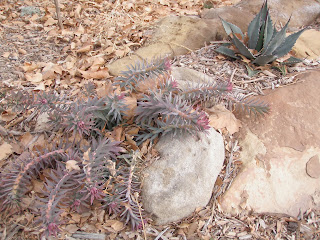
This lovely cousin is the anchor of my first and puny crevice garden.  It's basically the same size as the garden.  Which is good, becasue it looks awesome absolutely 13 months of the year.


In fact, Euphoribia was quite decorative in the -15F (-25C) realm last winter just days before the cold would turn that Havard's Agave into jelly.  This spurge is tough.

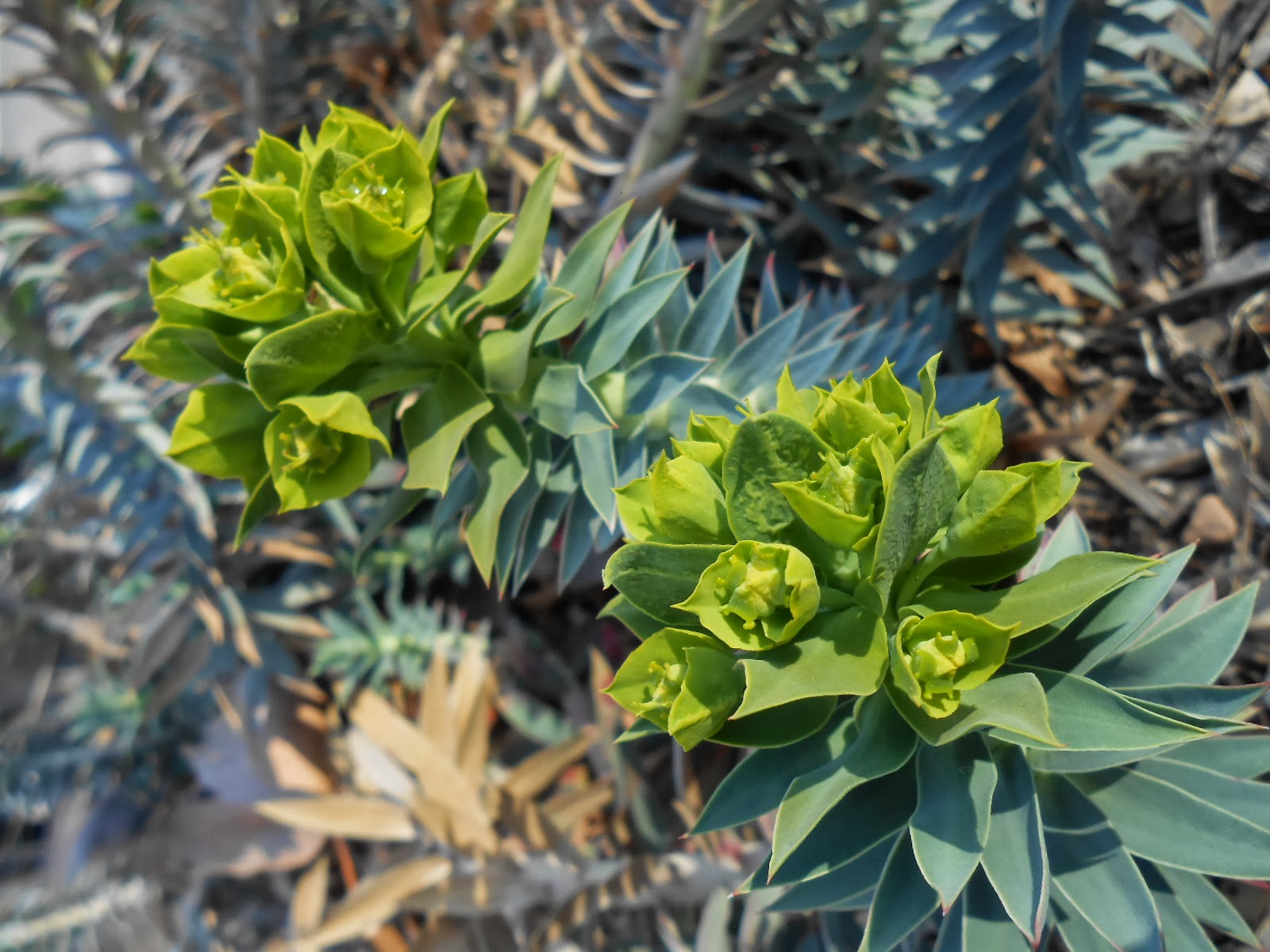
In spring, the flower buds glow cooly.


The ruddy flowers give way quickly to seedpods.  
This year, I discovered why its progeny were on such distant corners of the garden: While planting nearby, I kept feeling pricks against my cheek. Finally, I realised that the air-filled fruit become pressurised by the sun and explode their seed to distant places!

Just when the tired bloomed-out stems of this year finish, A new set of spiny octopus arms has already emerged to replace them looking oceanically regal.  A mass planting of this would look great near a schwanky new building, like so much brushed steel.

BUT- and this is a big but- It is reseeding about the garden, and looking quite nice in form in the dryest and even shadiest of places. Which at once pleases me and scares me.  I am watching you, oh Mediterranean Spurge.  If you are not the next horrendous weed, you are the prettiest dang thing.

Underappreciation Files #5: Night Phloxes.

Well, they may not strictly be night-bloomers. And they are close, but not really phloxes.
Call them "Prickly Phloxes" or scientifically (don't be afraid!) "Leptodactylon," which, if it helps, means "skinny fingers," which is a reference to the leaves, which individually look like a hand of slender pointy fingers.  

For the scientifically/taxonomically inclined, it looks like most species of these (save for L. californicum) have been re-assigned "Linanthus."  Whatever.

They are all from the dry American West, and rarely grown in gardens. There are perhaps half a dozen species, so by numbers it's easy to "collect them all," but by their horticultural scarcity and requirement of a dry garden to prosper, not so easy.

But they are totally worth it, three inches of pure joy.

Leptodactylon (Linanthus) watsonii.  Sold by Aguafria Nursery, I think. Being shy in daytime with its dark-rimmed night-flowers. Look closely and see how the leaves are not single needles as much as a set of needly lobes.

Leptodactylon (Linanthus) pungens, with characteristic "ropey" habit of stems, blooming this spring, not as shy in the daylight, in Rabbit Valley, far Western Colorado.

In a free-draining mix, I have found the seed easy to grow.  Plants are big enough to plant in less than a year, but transplanting seems where they are more fickle: my tests (resulting in the deaths of my beautiful plants) seem to indicate spring planting for these. (Neither summer nor autumn)  They do like crevice gardens. (As many, like L. caespitosum, grow in natural sandstone crevices)
Another fine plant for the parched and dry unwatered rockery.

If you are a collector, grow it!  If you are not, find out how!